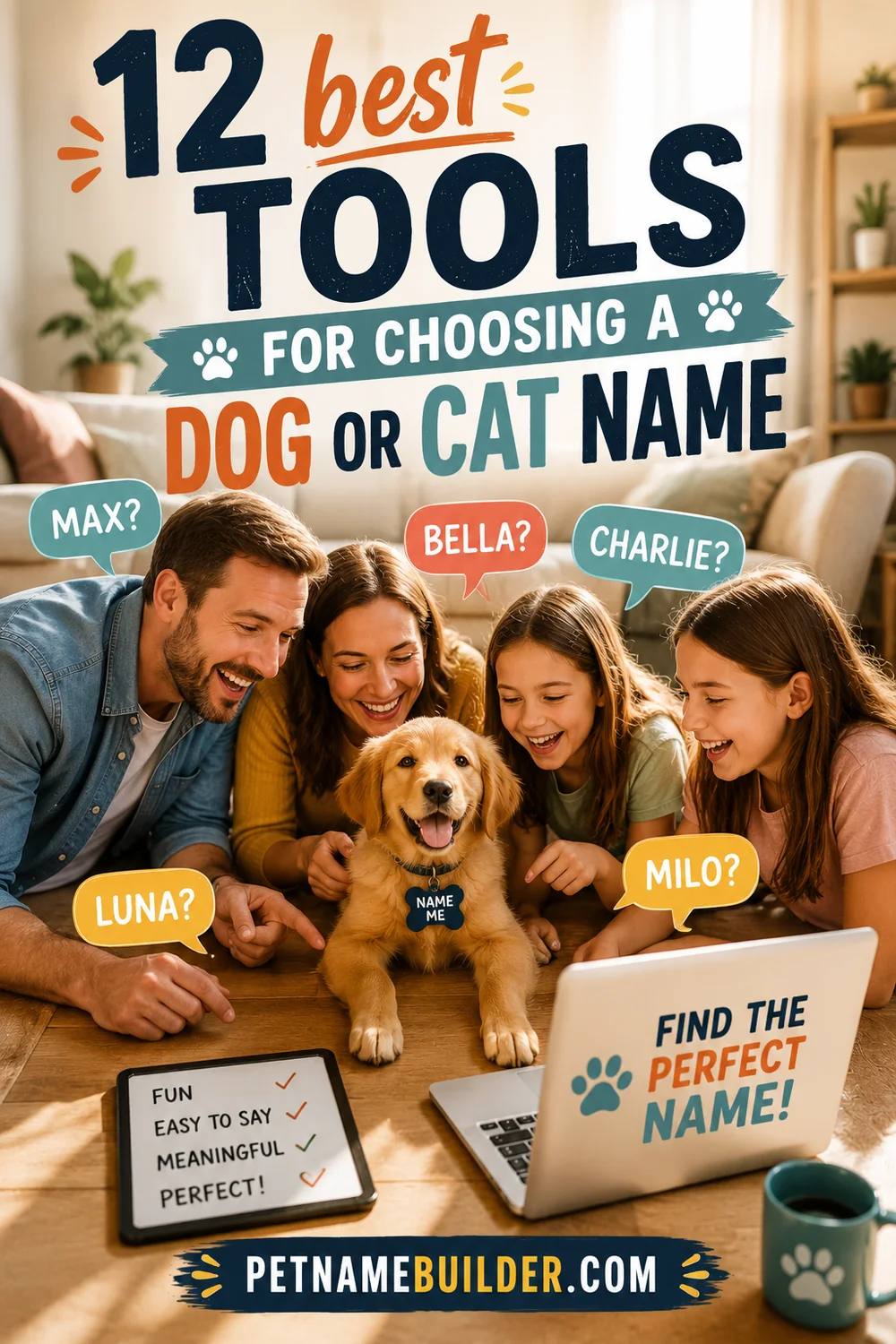
12 Best Tools for Choosing a Dog or Cat Name
The Right Tool Makes Finding the Right Name Much Easier
Choosing a name for your dog or cat is more consequential than it might seem. Your pet's name is the word they'll learn first, the word you'll say thousands of times, and the word that forms the foundation of your communication and bond. Choose well and you'll love saying it for the next 10–15 years. Choose in a rush and you might spend those same years with mild name regret.
The good news: there are excellent tools that make the process faster, more fun, and much more likely to end with a name you genuinely love. Here are the 12 best — from digital tools and expert frameworks to old-fashioned methods that still work beautifully.
1. Pet Name Builder — petnamebuilder.com ⭐
Why it's essential: Pet Name Builder is the most complete, well-designed free pet naming tool available. Search thousands of names filtered by pet type, breed, style, personality, and origin — all in a fast, clean interface with no signup required. Whether you want something elegant, playful, fierce, nature-inspired, or culturally specific, Pet Name Builder covers more ground more elegantly than anything else on this list. Start here, explore widely, and save your favorites before narrowing down. This is the tool that turns an overwhelming decision into an enjoyable one.
2. Breed-Specific Name Lists
Why it's great: Names that feel right for a Siberian Husky are different from names that feel right for a Maltese — and there's good reason for that. Breed-specific name lists, curated by people who know the breed's personality, history, and aesthetics, consistently surface names that feel authentic rather than generic. Look for breed-specific lists on sites like AKC.org, breed club websites, and Pet Name Builder's breed filter. A Malinois named "Shadow" or a Scottish Fold named "Thistle" feels intentional in a way that a random pick doesn't.
3. Meaning-Based Name Finders
Why it's great: Choosing a name based on meaning gives your pet's name depth beyond sound alone. Meaning-based finders let you search by concept — "brave," "gentle," "wild," "moon," "shadow," "warrior" — and discover names from multiple cultures that carry that meaning. This is a powerful approach for owners who want their pet's name to reflect something true about the animal's personality or about what they mean to their owner. Sites like BehindTheName and BabyNames.com both have excellent meaning-based search functions.
4. BehindTheName for Etymology
Why it's great: Behind the Name (behindthename.com) is the gold standard for name etymology. Every entry includes a full linguistic breakdown — what language the name comes from, what the root words mean, and how usage has shifted across history and cultures. For pet owners who want to truly understand a name before giving it, this is the deepest free resource available. Also excellent for finding names from underrepresented cultures that carry specific meanings.
5. AKC Name Search — akc.org
Why it's great: The AKC's name database is specifically designed for dogs and searchable by theme, gender, breed, and popularity. It also includes names from registered champion dogs, which is a rich and unusual source of dignified, distinctive names for dogs with presence. The AKC's name search is less visual than Pet Name Builder but thorough and trustworthy.
6. Social Security Name Database (for human-style pet names)
Why it's great: Giving pets human names is one of the dominant trends in pet naming — names like Theodore, Harriet, Walter, and Eleanor for dogs and cats are everywhere. The Social Security Administration's name database (ssa.gov/oact/babynames) is the best tool for exploring human names by popularity and decade. Want a human name that was popular in the 1920s but is now rare? Filter by decade and find it. The vintage human name trend in pet naming shows no signs of slowing down.
7. Name Voting Apps (Belly Ballot-Style)
Why it's great: Can't decide between your top three? Crowdsource it. Tools like Belly Ballot let you create a name list and share it privately with family and friends for voting. Everyone submits their ranking anonymously, and you see aggregate results. This removes the awkwardness of asking for opinions directly while still getting meaningful input. It also helps resolve the perennial partner disagreement — "we both get 10 votes on each other's list and find the overlap" is a time-tested naming negotiation strategy.
8. Family Brainstorm Session and List
Why it's great: Old-fashioned but effective. Sit down with your household (or text your inner circle), spend 15 minutes generating names without judgment — every idea welcome — and then review the list together. The goal in the first round is volume, not quality. Write down 30 names and then eliminate the obvious rejects. What remains often surprises you. This method works especially well when you're choosing a name for a family pet, because everyone feels heard and the final name feels collectively owned.
9. Trainer Consultation (Names With Hard Consonants Work Best)
Why it's great: Professional dog trainers have a practical perspective on names that naming enthusiasts often miss: some names are more trainable than others. Names that start or end with hard consonants — K, T, B, D, G — are easier for dogs to distinguish from ambient noise and conversation. Short names (1–2 syllables) work better than long ones. Names that sound like commands can cause confusion: "Kit" sounds like "sit," "Bo" sounds like "no." A 10-minute conversation with a trainer about your top name candidates is one of the most useful pre-adoption steps you can take.
10. Alliteration Test
Why it's great: Does the name flow with your last name, or with your other pets' names? Alliteration (Bella B., Max M.) and rhythmic pairing (short first name + long last name, or vice versa) can make a name feel more complete or more awkward. Say the full name — first and last — out loud several times. Names that feel good to say repeatedly are names you'll enjoy using. Names that feel clunky often never quite settle.
11. Nickname Test
Why it's great: Most pet names get shortened, sweetened, or modified over time. "Maximilian" becomes "Max" and then "Maxy" and then something entirely different. Think about what the likely nickname is for your top choices — and whether you love it as much as the full name. If the nickname is embarrassing, annoying, or one you'd actively avoid, reconsider the full name.
12. The 2-Syllable Rule Test
Why it's great: Animal behavior research consistently shows that dogs respond better to 2-syllable names than to 1-syllable or 3+ syllable names. The rhythm of 2 syllables creates a natural calling cadence: "Biscuit!" "Luna!" "Cooper!" "Maggie!" Run your top picks through this test — say each one as a command, a greeting, and a recall call. The ones that feel natural to say in all three contexts are your strongest candidates.
Frequently Asked Questions
What makes a good dog name?
Short (1–2 syllables), ends in a vowel sound if possible, starts or ends with a hard consonant, distinct from common commands (sit, stay, come, down), and a name you'll be comfortable saying in public and privately for 10–15 years.
What makes a good cat name?
Cats respond to names similarly to dogs — 1–2 syllables and vowel-ending names work best. The difference is that cats are less reliably responsive to recall by name, so the name matters more for your relationship with them than for training purposes. Choose something you love saying.
Should pet names match the pet's personality?
Many owners choose names based on initial impression and then find the personality grows into or away from it. Either way is fine. Some owners prefer to wait a few days after getting the pet to observe their personality before committing to a name.
How long does it take to choose a pet name?
Most owners choose within the first week. Having a name before the pet arrives is ideal so you can start using it immediately. If you need more time, that's fine — consistency matters more than speed, and a well-chosen name after a week is better than a rushed one on day one.
Can you rename an adult dog or cat?
Yes — adult pets adapt to new names within 1–2 weeks when the new name is consistently paired with positive reinforcement (treats, praise, attention). The transition is almost always smoother than owners expect.
🔗 More Pet Name Resources
Start With the Best Tool Available
Thousands of names, no signup, completely free. Your pet's name is here.
👉 Open the Pet Name Builder Free — thousands of names by breed, style, and personality. 🐾