Surprise Christmas Puppy or Kitten: Should You Name It First or Let the Kids Choose?
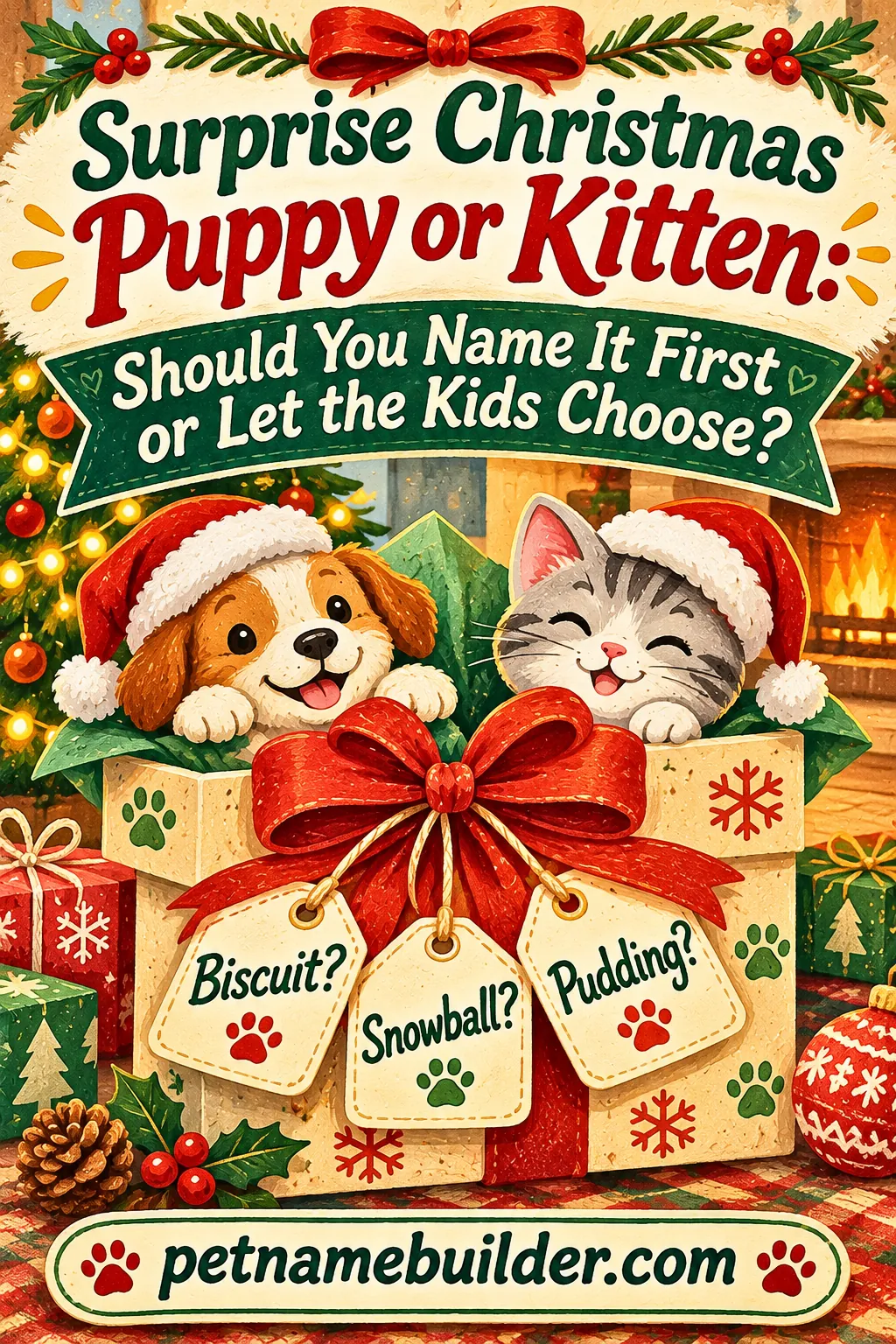
The best way to name a Christmas surprise puppy or kitten is to do both: you, the adults, quietly build a shortlist of three to five names you'd be happy to say for the next fifteen years, and the kids pick the winner from that list at the reveal or within a few days after. You keep veto power, and the kids get real ownership. The free Pet Name Builder makes the shortlist part easy, because you can filter by pet type, personality and gender, save the names you like and export them as a printable text list.
This guide walks through the trade-offs of naming first versus letting the kids decide, a step-by-step plan for building a reveal-day shortlist, word-for-word scripts for the big moment, what to do when siblings disagree, and how to handle the first few days when your new pet hears its name for the first time. There's also a timeline so you aren't scrambling on Christmas Eve.
🐾 Pick a name from this list
Tap Next for a name from this page, and save the ones you love.
Name It First or Let the Kids Choose? The Honest Trade-Offs
Parents usually land in one of three camps. Some want the name settled before the reveal so the gift tag, collar and stocking can say it. Some want the kids to choose freely because it's "their" pet. And some want a middle path. Here's how the three options compare.
| Approach | What it looks like | Biggest upside | Biggest risk | Works best for |
|---|---|---|---|---|
| Parents name it first | The pet arrives with a name on a tag | Name is ready for the collar, tag and vet form on day one | Kids may feel left out, or quietly call the pet something else | Toddlers, very busy households, pets that already have a name you love |
| Kids choose freely | Kids name the pet after the reveal, no limits | Big sense of ownership | Names you dislike, sibling fights, a name that changes three times in a week | One older child, families who truly don't mind any name |
| Shortlist, kids choose (recommended) | Parents pick 3 to 5 names, kids choose the winner | Kids feel in charge, parents stay comfortable | Takes 30 minutes of planning | Most families, especially with two or more kids |
The shortlist approach wins for most families for a simple reason. The name gets used by everybody in the house, many times a day, for the pet's whole life. You'll say it at the vet's front desk, shout it across a park and write it on forms. Kids should help choose, but adults are the ones who will be filling out paperwork and calling the pet in from the yard at bedtime, so a gentle filter makes sense.
When Naming It First Makes Sense
There are good reasons to name the pet yourself before the reveal:
- Your kids are very young. A two- or three-year-old will happily name a puppy "Puppy" or "Banana." If you want something a little more lasting, choose it yourself and let the toddler "help" by saying it first.
- You want a personalized tag or stocking ready on Christmas morning. Engraved tags and embroidered items often need to be ordered weeks ahead, so the name has to be decided early.
- The pet is coming from a shelter or breeder with a name it already knows. An older puppy or kitten may already turn its head to a name. Keeping it, or picking something that sounds close, can help the pet settle.
- The surprise is for one child and the others are much younger. Sometimes it's simpler for the parent and the main child to plan it together, then reveal to everyone.
When Letting the Kids Choose Makes Sense
Letting kids choose with no list at all can work too, especially if:
- You have one child who's old enough to think about it (around eight and up) and you trust their taste.
- You genuinely don't mind a silly name. Some families love having a cat named Pickles Pancake.
- You're willing to let the name "settle" over a week before you order anything engraved.
If you go this route, set a single rule out loud: "We'll try the name for three days before it's official." That buys time if the first choice turns out to be a bit much.
Why the Shortlist Works for Most Families
A shortlist turns a giant, open-ended decision into a small, fun one. Kids aren't overwhelmed by the thousands of possible names. You aren't stuck with a name you can't stand. And it gives the reveal a built-in activity: after the gasps and the first cuddle, there's a "now you get to name them" moment that kids remember.
The trick is making sure every name on the list is a name you'd be happy with. Never put a "joke" option on the list that you secretly don't want. Kids have a sixth sense for picking the one you were hoping they'd skip.
How to Build a Parent-Approved Shortlist with the Free Tool
You can do this in about half an hour after the kids are in bed. The Pet Name Builder won't hold a vote or keep a family account, but it gives you a big pool of names with meanings, lets you save the good ones and exports them as a plain text file you can print or copy onto cards. Here's the exact process.
Step 1: Pick the Right Tab for What You Know
What you already know about the pet decides where to start.
- You know the pet type and whether it's a boy or girl. Use the 🔍 Browse Names tab. Under 🐾 Pet Type, tap Dogs or Cats. Under ⚧ Gender, tap ♂️ Boy, ♀️ Girl or ⚪ Unisex. If you've met the puppy or kitten, add a 💫 Personality (Playful, Calm, Bold or Elegant) and a 🎨 Color & coat such as Black, Golden, Tabby, Tuxedo or Brindle. Then tap Find Perfect Names 🐾.
- You know the breed. Tap 🐕 By Breed, choose the pet type (Dogs, Cats, Birds, Small Pets, Fish or Reptiles), tap the breed in the grid, then Get Names for This Breed 🐾.
- You want a theme kids will get excited about. Tap 💡 By Meaning and choose 🍪 Food, 😄 Joy, 🌿 Nature, ⭐ Celestial, 💪 Strength, 🐉 Mythology or ✨ Quirky, then tap Show Names with This Meaning 💡. Food and Joy names tend to be big hits with younger kids.
- You haven't met the pet yet and want a quick, personal mix. Use the ❓ Personality Quiz. Answer all five questions (pet type, energy level, personality, name style and vibe), then tap Get My Top 10+ Names 🎯 for your top 15 matches. If your kids are little, choose 📍 Short & Snappy for name style. The quiz gives extra weight to names of five letters or fewer, which are easier for small mouths.
Step 2: Save Generously, Then Cut Hard
On the results screen, each name card shows the name, its meaning and a short "why it works for pets" note. Tap ♡ Save on anything that makes you smile; it switches to 💕 Saved. Tap a card to open the full details, where you'll also see what kinds of pets the name suits. If the grid ends with a Load More button, keep going. Aim to save 10 to 20 names in this first pass.
Then open 💕 Favorites from the top menu. That's your saved list. Now cut it down using the checks in the next section, removing names with the × button, until you have three to five left. Your saved names stay in that browser on that device, so you can come back to the list the next night without starting over.
Step 3: Export and Print
Tap 📥 Export as Text. The tool downloads a file called pet-names.txt with one name and its meaning per line. That's your reveal-day material. You can print it as is, copy each name onto an index card, or write them on paper ornaments for the tree. Keep the meanings; kids love hearing that a name "means moon" or "means honey."
Step 4: Use Surprise Me for a Wild Card (Optional)
If the list feels a bit predictable, tap ✨ Surprise Me! in the top menu a few times. It opens a random name card. Every so often, it turns up a gem you'd never have searched for. Only save it if it passes the same checks as the others.
A Worked Example: Two Kids, One Golden Puppy
Here's how one plan might look. The family is getting a ten-week-old golden retriever puppy, a girl, for a seven-year-old and a ten-year-old.
- On 🔍 Browse Names, the parents tap Dogs, Playful, Golden and ♀️ Girl, then Find Perfect Names 🐾.
- They save 14 names, including a couple of food names and a couple of classics.
- They switch to 💡 By Meaning, choose 🍪 Food and save three more sweet-treat names.
- In 💕 Favorites, they cut the list to five names using the checks below. They make sure every name passes the "would I say this at the vet?" test.
- They tap 📥 Export as Text, print the file and cut it into five strips, one name per strip.
- On Christmas morning, the strips go into a small envelope tied to the puppy's crate with the note "Your puppy needs a name. Pick one together."
Total planning time: about 25 minutes. Arguments avoided: probably several.
Six Quick Checks Every Shortlist Name Should Pass
Before a name makes the final cut, run it through these checks. They take a minute per name and save you from the most common regrets.
| Check | How to test it | Pass example | Fail example |
|---|---|---|---|
| The shout test | Say it loudly, as if calling the pet from the backyard | "Maple!" | "Sir Fluffington the Third!" |
| The command test | Does it sound like sit, stay, no, down or come? | Hazel | Kit (sounds like sit) |
| The family test | Does it match or rhyme with someone's name in the house? | Pepper, if nobody is Peggy | Molly, if your daughter is Holly |
| The little-kid test | Can your youngest say it clearly? | Bean, Milo, Teddy | Persephone |
| The vet-desk test | Would you be comfortable saying it in a waiting room? | Clover | Anything you'd whisper |
| The July test | Will it still feel right in midsummer? | Juniper, Hazel | Tinsel |
The Command Test, in More Detail
Dogs especially learn by sound, so a name that rhymes with a common cue can cause mix-ups in training. "Kit" sounds a lot like "sit." "Bo" sounds like "no." "Shay" sounds a little like "stay." "Ray" and "Fay" can blur with "stay" too. It isn't a disaster if you love one of these, but if you're choosing from scratch, there's no reason to make training harder. Our guide on how to choose a pet name goes deeper on sound, length and syllables.
The July Test
It's tempting to put festive names on a Christmas shortlist: Jingle, Tinsel, Sleigh Bell and so on. They're adorable on December 25 and can feel a little odd by the Fourth of July. That doesn't mean skip them. It means balance the list. A good mix is one or two lightly festive names that still work all year, like Juniper, Holly, Nutmeg or Cocoa, plus two or three everyday favorites. If you want ideas that sit on the festive side, our Christmas pet names list has plenty to choose from.
Keep the List Short
Three to five names is the sweet spot. Two names can feel like a forced choice. Eight names turns the reveal into a long debate while the puppy chews the wrapping paper. With three to five, kids can read each one aloud, try it on the pet and pick a favorite in a few minutes.
Reveal-Day Plans and Scripts That Actually Work
The reveal is chaotic in the best way. Kids squeal, the puppy wiggles, the kitten hides under the couch. Don't expect a calm naming ceremony in the first five minutes. Plan for the name to come a little later in the morning, once everybody has had their first cuddle.
Here are four reveal formats, with what to say for each.
Format 1: The Name Envelope
Tie an envelope to the crate, carrier or bed. Inside, put your shortlist on strips of paper.
What to say: "This little one came all the way here for you, and there's one thing missing. They don't have a name yet. Everything in this envelope is a name Mom and Dad already love. You two get to choose which one it is."
Why it works: the kids know from the start that every option is a "yes," so nobody feels tricked, and the choosing becomes part of the gift.
Format 2: Ornament Vote
Write each shortlist name on a paper or wooden ornament and hang them on the tree the night before. After the reveal, each child picks the ornament they like best. If they agree, that's the name. If they don't, use one of the tie-breakers in the next section.
What to say: "See those new ornaments on the tree? Each one has a name on it. Go find the one you think fits our puppy best and bring it here."
Why it works: it gets kids moving, gives the pet a breather, and the winning ornament becomes a keepsake you hang every year.
Format 3: The Call-and-Look Test
Sit in a circle on the floor with the pet in the middle. Each child calls one shortlist name in a happy voice. Whichever name gets a head turn, a tail wag or a wobbly walk over gets a point. Do two rounds.
What to say: "Let's let the puppy help. Everybody gets to call one name nicely. Let's see which one she likes."
Why it works: kids love the idea that the pet "chose." Honestly, a young puppy or kitten is reacting to a friendly voice, not the name itself, but it's a sweet way to break a tie and it keeps the moment calm.
A note on kittens: many kittens hide for the first hours or days in a new home. Don't pull a kitten out to play this game. Do it later in the week when it's comfortable, and let the name sit as "maybe" until then.
Format 4: The Name Box Gift (for When the Pet Comes Later)
Plenty of families can't bring the pet home on Christmas morning. The breeder's puppy may not be old enough, or you'd rather pick up a shelter pet after the holiday rush. In that case, the gift is a box with a collar, a toy, a photo of the pet if you have one, and the shortlist.
What to say: "Our new puppy comes home in two weeks. Your job until then is to pick the name. Here are the choices."
Why it works: it stretches the excitement over the waiting period, and kids get time to try each name out loud before the pet arrives. A quieter homecoming after the holiday rush is also easier on a young animal than a loud, crowded morning, so this format is worth considering anyway.
Scripts for Different Ages
| Child's age | What they can handle | Script idea |
|---|---|---|
| 2 to 4 | Choosing between two names, saying the name first | "Should she be Bean or Milo? You say it first!" |
| 5 to 7 | Choosing from 3 to 4 names read aloud | "I'll read four names. Raise your hand for your favorite." |
| 8 to 11 | Reading the list, giving reasons, light debate | "Pick your top two and tell us why." |
| 12 and up | Adding one name to the shortlist themselves | "You can add one name to the list if Mom and Dad agree." |
Teenagers often want more say than a younger sibling. Letting a teen add one name (subject to the same checks) is a fair way to give them extra input without making the younger kids feel outranked.
When Siblings Disagree: Fair Tie-Breakers
Two kids, two favorite names, one puppy. It happens in nearly every family with more than one child. Have a tie-breaker ready before the reveal so you aren't inventing rules on the spot.
Tie-Breakers That Feel Fair
- Ranked choice. Each child ranks every name from favorite to least favorite. On a four-name list, give 3 points for first, 2 for second, 1 for third and 0 for last. Add them up. The highest total wins. This usually finds the name everyone likes at least a little.
- Name plus nickname. One child picks the official name, the other picks the everyday nickname. "Juniper" can be "Junie." "Theodore" can be "Teddy." This is the most peaceful option when both kids feel strongly.
- First name and middle name. Pets don't need middle names, but kids adore giving them. One name goes first, the other becomes the middle name used when the puppy steals a sock.
- The pet decides. Use the call-and-look test from the last section, best two out of three.
- Coin flip with a consolation prize. The child who "loses" chooses the color of the collar or picks the first toy. Everybody wins something.
A Worked Tie-Break
Say there are three kids and a shortlist of Hazel, Pepper, Clover and Maple. Here are their rankings, scored 3 for first place, 2 for second, 1 for third and 0 for fourth:
| Name | Child A | Child B | Child C | Total |
|---|---|---|---|---|
| Hazel | 3 | 1 | 2 | 6 |
| Pepper | 2 | 3 | 0 | 5 |
| Clover | 1 | 2 | 3 | 6 |
| Maple | 0 | 0 | 1 | 1 |
Hazel and Clover tie at 6. Now do a simple head-to-head: each child votes for Hazel or Clover. If it's 2 to 1 for Clover, Clover wins, and Hazel becomes the middle name. Nobody walks away empty-handed, and the math makes the result feel fair.
Before and After the Reveal: A Holiday Naming Timeline
Bringing home a pet at Christmas means juggling the surprise, the supplies, the visitors and the name. Here's a simple timeline that keeps the naming piece on track.
| When | What to do |
|---|---|
| 6 or more weeks before | Talk with every adult in the home and agree you're ready for a pet. Confirm the breeder or shelter's pickup date and their holiday schedule. |
| 4 to 5 weeks before | Build your shortlist with the Pet Name Builder, run the six checks and narrow it to 3 to 5 names. |
| 3 to 4 weeks before | If you want a personalized tag, stocking or collar ready for Christmas, either decide the name now or buy a blank item and personalize it later. Check your seller's order cutoffs and your carrier's official holiday shipping dates. |
| 1 to 2 weeks before | Print the shortlist, make the envelope or ornaments, set up the crate or litter area, and book a first vet visit for the first week or two after homecoming. |
| Christmas Eve | Hang the ornaments or prepare the envelope. Pick a quiet room for the pet. Brief any grown-up helpers on the plan. |
| Christmas Day | Reveal first, name a little later in the morning. Keep the pet in a calm spot as the day gets busy. |
| Days 1 to 3 | Use the chosen name often, in a happy voice. Hold off on engraving until it sticks. |
| Week 1 to 2 | Order the engraved tag and update the microchip registration with the name and your contact details. |
A Note on the Tag
An ID tag matters more than the name itself. Holiday homes have doors opening for guests all day, and a new pet doesn't know where home is yet. If the name isn't settled on Christmas morning, put your phone number on a temporary tag and add the name later. Our guide on what to put on a dog tag covers what to include.
Keeping the Surprise Safe for the Pet
A surprise is fun for people, but a puppy or kitten doesn't know it's part of a big moment. A few habits keep the reveal kind to the animal:
- Skip the closed gift box. A pet should never be wrapped, boxed or left in a closed container. An open crate with a bow on top gives you the same "wow" without the risk.
- Keep the hiding time short. If the pet arrives the night before, keep it in a quiet, warm room with water, a bed and, for kittens, a litter box. Have an adult check on it.
- Plan the noise. Ask kids to use "inside voices" for the first meeting and to sit on the floor so the pet can come to them.
- Watch the wrapping paper and ribbon. Puppies and kittens chew and swallow ribbon, tinsel, string and small toy parts. Clear the floor after presents are opened.
- Keep holiday food out of reach. Chocolate, grapes, raisins, onions, fatty scraps, bones and anything with xylitol aren't safe for pets. Call your vet right away if your pet eats something it shouldn't, even if it seems fine.
The First Week: Helping Your New Pet Learn Its Name
Once the name is chosen, the real work starts. The good news: young puppies and kittens can start responding to a name within days if everyone in the house uses it the same way.
Day-by-Day Name Practice
| Day | What to do | Time needed |
|---|---|---|
| Day 1 | Say the name in a happy voice when the pet looks at you, then give praise or a small treat | 2 to 3 minutes, a few times |
| Day 2 | Say the name from a few feet away. Reward any glance your way | 3 sessions of 2 minutes |
| Day 3 | Kids take turns saying the name from across the room | 3 sessions of 3 minutes |
| Days 4 to 5 | Say the name when the pet is a little distracted, like sniffing a toy | 3 sessions of 3 minutes |
| Days 6 to 7 | Use the name before every good thing: meals, play, cuddles | Built into the day |
Short, happy sessions work better than long ones. A ten-week-old puppy has a tiny attention span, and kittens tend to wander off once they're bored. Two minutes of success beats ten minutes of frustration.
Rules for Kids
Kids are usually the most eager trainers and the most likely to accidentally confuse the pet. Give them three simple rules:
- Say the name only for good things. Never use it to scold. If the puppy chews a shoe, say "uh-oh" and move them, not "Biscuit, no!"
- Say it once, not five times. "Biscuit!" and then wait. "Biscuit Biscuit Biscuit Biscuit" teaches the pet to ignore the first four.
- Everyone uses the same name. Nicknames are lovely later, but in week one, stick with the chosen name so the pet hears one clear sound.
What If the Name Isn't Working?
Sometimes a family picks a name and realizes within a week that it's just not right. Maybe it sounds too much like a sibling's name, or nobody naturally says it. That's okay. Early on, changing a name is easy, especially if you pick something with a similar sound. A puppy that's heard "Clover" for four days will switch to "Cleo" or "Coco" quickly. Use the same day-by-day practice with the new name. If the switch involves a rescue that came with a name, our guide to renaming a rescue dog walks through it.
Variations: Toddlers, Teens, Big Families and Grandparents
Every family looks a little different. Here's how to adapt the shortlist plan.
Toddlers and Preschoolers
Little kids want to be part of it but can't really weigh options. Keep the list to two names, both short and easy to say: Bean and Milo, or Pip and Teddy. Let the toddler pick and be the first to say it to the pet. If they pick "Puppy," smile and offer the two again later. Many toddlers will happily repeat whatever the older kids are saying by the end of the day.
One Older Child
If the pet is mostly for one eight- to twelve-year-old, consider letting them build part of the list with you. Sit together with the Pet Name Builder (before the surprise, you can frame it as "just for fun" or "for a friend's puppy") and notice which names they light up at. Save those quietly. On the day, the shortlist will be full of their favorites, and it'll feel like magic.
Big Families (Four or More Kids)
With four or more kids, voting on one name can get loud. Try this:
- Use a five-name shortlist.
- Each child gets one sticker dot to place on the name they like most, and a second dot for their runner-up.
- The name with the most dots wins.
- The runner-up becomes the middle name or the nickname.
The sticker method works because it's quick, visual and doesn't require anyone to argue out loud.
Grandparents and Relatives
At the holidays, grandparents and aunts often have opinions too. Decide in advance whether they get a vote. A gentle approach: they can suggest one name for the shortlist before Christmas, but on the day, only the kids vote. That keeps the moment centered on the children while still letting relatives feel included.
Troubleshooting Common Naming Snags
| Problem | Why it happens | Fix |
|---|---|---|
| Kids reject every name on the list | The list feels like the parents' choice, not theirs | Let each child swap one name for a new one, as long as it passes the six checks |
| A child picks a joke name you can't live with | No list, or a "joke" option snuck onto it | Offer it as the middle name or a playful nickname, keep the official name from the list |
| The name keeps changing every day | No deadline was set | Set a deadline ("official by Sunday"), then stick with it |
| The pet already responds to a shelter name | It heard that name for weeks | Keep it, or choose a shortlist name with the same first sound |
| Grandparents keep calling it something else | Habit, or they missed the vote | Give them a fun role, like announcing the name at dinner, so they hear and say it often |
| The engraved tag has the wrong name | It was ordered before the vote | Use a temporary phone-number tag, then reorder once the name sticks |
| The kitten won't come out for the naming game | It's still settling in | Name it from the list anyway, practice once it's comfortable |
Here's the whole plan in one breath: agree as adults, build a list in the free Pet Name Builder, save 10 to 20 names, cut to three to five with the six checks, export and print them, then let the kids choose at the reveal or soon after. Keep a tie-breaker in your back pocket, use the name kindly and consistently for the first week, and wait to engrave until it sticks.
Frequently Asked Questions
Should parents or kids name a Christmas surprise puppy?
Both, in most cases. Parents build a shortlist of three to five names they'd be happy with, and the kids choose the winner. Kids get real ownership, and adults avoid a name they'll dislike saying for years.
How many names should be on a reveal-day shortlist?
Three to five is the sweet spot. Two can feel like a forced choice, and more than five tends to turn the reveal into a long debate. For toddlers, offer just two short, easy names.
Is it okay to wait a few days to name a new puppy or kitten?
Yes. A few days is fine, especially if the pet is shy or the house is busy. Pick a clear deadline, like the end of the weekend, so the pet starts hearing one consistent name soon.
What if my kids can't agree on a name?
Use a simple point system: each child ranks the names, first place gets the most points, and the highest total wins. If there's still a tie, do a head-to-head vote or let one child choose the official name and the other choose the nickname or middle name.
Can the Pet Name Builder run a family vote?
No. It doesn't have voting or shared family accounts. It helps you find names by pet type, gender, personality, coat color, breed or meaning, save favorites and export them as a text file. You can print that file and run the vote on paper, with ornaments or with sticker dots.
Should I put the name on a tag before Christmas?
Only if the name is already final. Otherwise, use a temporary tag with your phone number and order the engraved one after the name has stuck for a few days. Update the microchip registration once it's settled.
Are Christmas-themed names a good idea for a holiday puppy?
They can be, but balance them. Names like Juniper, Holly, Nutmeg and Cocoa feel festive yet still work in summer. Very seasonal names like Tinsel or Jingle are adorable but may feel odd by July, so put at most one on the list.
How long does it take a puppy or kitten to learn its name?
Many young pets start reacting within a few days to a week when everyone uses the name the same way. Keep sessions short and happy, say the name once and reward any glance your way.