Relatives Fighting Over the New Pet's Name at the Holidays? Run a Family Vote
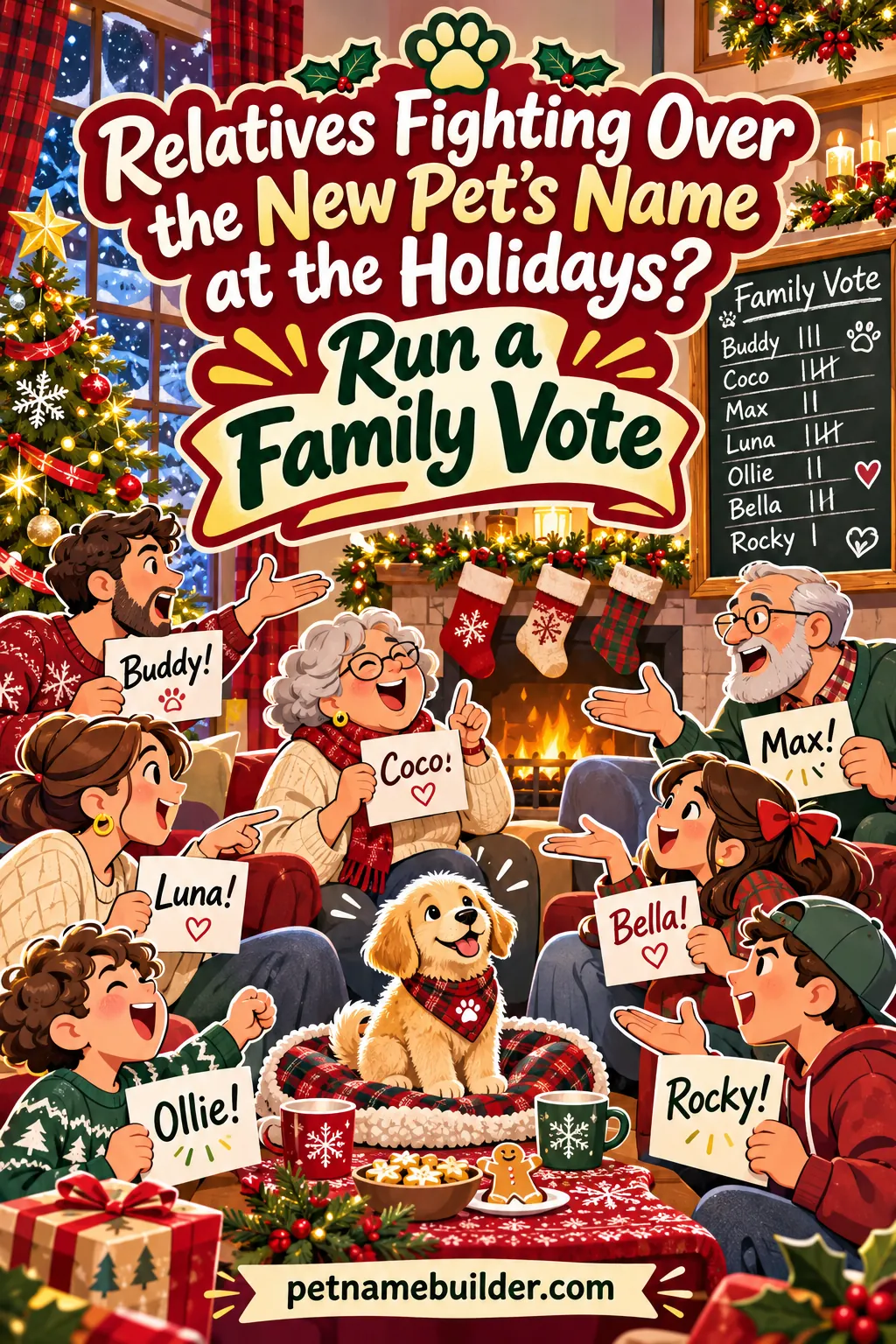
When every relative at the holiday gathering has a different name for your new pet, stop the open debate and run a short family vote on pet name finalists: the people who live with the pet pick three names, everyone else votes, and the household keeps a final veto. It takes about ten minutes, everybody gets heard, and nobody leaves the table sulking. The free Pet Name Builder helps you build those three finalists fast, with names you can filter by pet type, gender, personality, coat color, breed or meaning.
Below you'll find a step-by-step plan, ballot formats for big and small crowds, scripts for the awkward moments, a worked vote with real numbers, and a troubleshooting table for when Uncle Ray refuses to drop "Meatball."
🐾 Pick a name from this list
Tap Next for a name from this page, and save the ones you love.
Why Holiday Name Fights Happen (and Why a Vote Fixes Them)
A new puppy or kitten at a holiday gathering is the center of attention. That's lovely, and it's also a recipe for a naming free-for-all. Every relative gets to hold the pet, every relative gets an idea, and suddenly there are fourteen names on the table and three people who feel strongly about each one.
The problem usually isn't the names themselves. It's that nobody knows who actually gets to decide. Grandma assumes her opinion counts because she raised four dogs. Your teenager assumes it counts because it's "basically their dog." Your sister-in-law has a name she's been saving for years. When the decision process is unclear, every suggestion turns into a small contest.
A family vote fixes that by making the rules visible. Here's what a clear process does:
- It separates suggesting from deciding. Anyone can suggest. Only the shortlist goes to a vote. Only the household confirms the winner.
- It gives everyone a real role. Relatives who vote feel included, even if their favorite loses.
- It ends the debate. Once the votes are counted, the discussion is over. No more "but what about…" during dessert.
- It protects the people who'll live with the name. You're the one saying it at the vet, shouting it in the yard at 6 a.m. and writing it on forms. Your veto keeps a joke name from sticking.
Who Should Get a Say?
Decide this before anyone arrives, not in the middle of the argument. Here are three common setups:
| Setup | Who suggests | Who votes | Who has the final say | Best for |
|---|---|---|---|---|
| Household only | Everyone | Only people who live with the pet | Household | Families who want relatives involved but not deciding |
| Open family vote | Everyone | Everyone at the gathering, including kids | Household can veto, but rarely does | Close families who love a group activity |
| Weighted vote | Everyone | Everyone, but household votes count double | Household | Big gatherings where relatives outnumber the household |
Most families do best with the open family vote plus a household veto. It's generous, it's fun and it still protects you from a name you can't stand. If relatives outnumber your household three to one, the weighted vote keeps the result from being decided entirely by people who'll see the pet twice a year.
Say the Rules Out Loud
The single most useful thing you can do is announce the plan before the suggestions fly. Something like this works well:
"We'd love everyone's help naming her. Here's how it'll work: we picked three finalists, everybody gets a vote after dinner, and we'll announce the winner with dessert. If something truly doesn't fit our house, we keep a veto, but we'll try hard not to use it."
That one paragraph sets expectations, signals that you're the household and gives everyone something to look forward to. People argue less when they know there's a fair process coming.
Step 1: Build a Shortlist of Three with the Free Tool
The ballot only works if every name on it is one you'd be glad to live with. That's why the household builds the shortlist privately, before the vote. Three names is the sweet spot: enough for a real choice, few enough that the vote stays quick and the winner gets a clear majority more often.
The Pet Name Builder doesn't run votes or hold shared family accounts. It's a name finder. You use it to collect good options, save them, and export them as a text list you can print or copy onto ballots. Here's the exact process, start to finish, in about twenty minutes.
Pick the Right Tab
Start in whichever tab matches what you know about the pet.
- You know the pet type and gender. Open 🔍 Browse Names. Under 🐾 Pet Type, tap Dogs, Cats, Birds, Small, Fish or Reptile. Under ⚧ Gender, choose ♂️ Boy, ♀️ Girl or ⚪ Unisex. If you know the pet's temperament, add a 💫 Personality (Playful, Calm, Bold or Elegant) and a 🎨 Color & coat, such as Black, Golden, Ginger, Tabby, Tuxedo, Brindle or Spotted. Tap Find Perfect Names 🐾.
- You know the breed. Tap 🐕 By Breed, choose the pet type, tap the breed in the grid, then tap Get Names for This Breed 🐾.
- You want a theme the whole family can rally around. Tap 💡 By Meaning and choose 🍪 Food, 😄 Joy, 🌿 Nature, ⭐ Celestial, 💪 Strength, 🐉 Mythology or ✨ Quirky, then Show Names with This Meaning 💡. Food and Nature names tend to please both kids and grandparents.
- You want a personal mix based on the pet. Use the ❓ Personality Quiz. Answer all five questions: pet type, energy level, personality, name style and vibe. Then tap Get My Top 10+ Names 🎯. If young kids or older relatives will be saying the name a lot, choose 📍 Short & Snappy as the name style.
Save Wide, Then Cut to Three
Each result card shows the name, its meaning and a short note on why it works for pets. Tap ♡ Save on anything you like; the button switches to 💕 Saved. Tap a card to open the full details. If more results are waiting, a load-more button appears at the bottom of the grid, so keep scrolling until you've seen enough.
Aim for 12 to 20 saved names on this first pass. Then open 💕 Favorites from the top menu. That's your saved list, and the names stay in that browser on that device, so you can come back the next evening. Cut the list down with the × button using the checks in the next section until three remain.
Export Your Finalists
Tap 📥 Export as Text. The tool downloads a file called pet-names.txt with one name and its meaning per line. That's your ballot source. Print it, or copy the three finalists and their meanings onto cards. Meanings help a lot at a family vote. Telling the table that "Juniper" is an evergreen shrub, or that a name means "bright" or "honey," gives people a reason to like it beyond the sound.
A Worked Example: Rescue Kitten, Twelve Relatives
Here's how one household might do it. A couple adopts a calm gray kitten, a girl, a week before a big family gathering. They expect twelve guests.
- On 🔍 Browse Names, they tap Cats, ♀️ Girl, Calm and Gray, then Find Perfect Names 🐾. They save 11 names.
- They switch to 💡 By Meaning, choose 🌿 Nature and save four more.
- In 💕 Favorites, they have 15 names. Using the checks below, they cut it to Willow, Juniper and Hazel.
- They tap 📥 Export as Text, then copy the three finalists and meanings onto a small card for the table.
Total time: about 20 minutes. The couple agreed on three names they both genuinely like, so whichever one wins, they're happy.
Run Every Finalist Through Five Quick Checks
Before a name reaches the ballot, test it. A family vote is only fair if every option is a real option. If you put a name on the list that you'd veto, you're setting up a fight, because it's always the one Grandpa votes for.
| Check | How to test it | Pass | Fail |
|---|---|---|---|
| The shout test | Call it loudly, as if from the back door | "Maple!" | "Princess Snowflake Buttercup!" |
| The command test | Does it rhyme with sit, stay, no, down or come? | Hazel | Kit (sounds like sit), Bo (sounds like no) |
| The family test | Does it match or rhyme with someone in the house, or a relative you see often? | Clover, if nobody is Cleo | Lily, if your niece is Lilly |
| The everyone test | Can your youngest and oldest relatives say it clearly? | Milo, Olive | Xiomara, Thaddeus |
| The July test | Will it still feel right in midsummer? | Juniper, Ginger | Tinsel, Jingles |
Why the Family Test Matters at the Holidays
This one catches a lot of families off guard. At a holiday gathering, the people in the room are the people who'll visit the pet for years. If your sister's daughter is named Rosie and the vote lands on Rosie for the puppy, that's an awkward family dinner every year from now on. Scan the guest list before you finalize the shortlist.
The Command Test, Briefly
Dogs pick up words by sound. A name that rhymes with a common cue can make training slower. That matters less for cats, birds or small pets, but it's still a good habit. For a deeper look at sound and syllables, see our guide on how to choose a pet name.
Balance Festive and Everyday Names
It's tempting to fill a holiday ballot with festive picks. One festive name is plenty. A good three-name ballot often looks like this: one name with a light seasonal feel that works all year (Juniper, Holly, Nutmeg, Cocoa), one classic (Hazel, Milo, Rosie) and one playful option (Pepper, Biscuit, Scout). If you'd like more seasonal ideas to choose your festive finalist from, browse our Christmas pet names list.
Step 2: Collect Suggestions and Handle the Awkward Moments
Relatives will suggest names whether you invite them or not. The trick is to give those suggestions somewhere to go. Here are two ways to welcome ideas without letting them take over the vote.
Option A: Suggestions Before the Gathering
A week or two before the holiday, send a group message: "We're naming the new kitten at Christmas dinner. If you have a name idea, send it to us by the 20th, and we'll consider it for the final three." Then run every suggestion through the same five checks. If a relative's idea makes the shortlist, tell them. It's a nice moment, and it gives them a stake in the vote.
This works best for large families spread out over several homes, because it moves the debate away from the dinner table and into a quiet week beforehand.
Option B: The Suggestion Jar
On the day, set out a jar or bowl with slips of paper. Anyone can drop in a name. Before the vote, the household reads every slip privately and decides whether one deserves a spot as the "people's choice" finalist. That gives you a four-name ballot: your three plus one crowd favorite, if it passes the checks.
Read the slips out loud afterward, even the silly ones. Half the fun of the jar is hearing what Cousin Theo came up with.
What to Say When a Suggestion Won't Make the Cut
You'll need a polite way to say no. These lines work:
- "That's a fun one. It sounds a lot like 'no,' so we're worried about training, but we'll keep it as a nickname."
- "We love it, but it's too close to Lily's name. We don't want any mix-ups at family dinners."
- "We're saving that one. If we ever get a second pet, it's top of the list."
That last line is gold. It's true often enough, and it leaves the relative feeling good.
Scripts for the Awkward Moments
Even with a good plan, holiday gatherings come with feelings. Here's what to say in the situations that come up most.
When a Relative Has Already Started Using "Their" Name
It happens fast. Your dad has been calling the puppy "Buster" since he walked in the door. Before the vote, say it lightly: "Dad, we know you love Buster. We're not settled yet, so can you hold off until after the vote? We don't want to confuse her." If Buster isn't a finalist, offer him a role: "You get to announce the winner."
When Someone Lobbies the Kids
Some relatives quietly campaign. Grandma tells the kids she'll be sad if they don't vote for Rosie. A gentle reset works: "Everyone gets to vote for whatever they like best, and nobody's feelings get hurt either way. That's the rule." If you're using secret ballots, the lobbying matters a lot less.
When Someone's Favorite Loses
Acknowledge it, then give them something. "Aunt Jen, Clover came so close. Would you like to pick her middle name?" or "Want to be the first one to say Pepper to her?" A small honor goes a long way.
When Your Partner Wants a Different Name Than You
Sort this out before the gathering. If the two adults in the household can't agree on three finalists, the family vote will expose that in front of everyone. Sit down together with the Pet Name Builder, each save names separately on your own devices, then compare lists and pick the overlaps. Any name you both saved independently is a strong finalist.
Step 3: Choose a Ballot Format That Fits Your Crowd
How you vote depends on how many people are voting and how old they are. A quiet household of four and a loud gathering of twenty-five need different setups.
| Group size | Best format | Time needed | Supplies |
|---|---|---|---|
| 3 to 6 people | Show of hands, then a ranked tie-break | 3 to 5 minutes | None |
| 7 to 15 people | Paper ballots or sticker dots | 8 to 10 minutes | Paper strips, pens or sticker dots |
| 16 or more people | Sticker dots on a poster | 10 to 15 minutes | Poster board and sticker dots |
| Spread across homes | Group chat poll or a photo of the finalists, one vote per person | One day, with a set deadline | A phone |
Format 1: Show of Hands
Read each finalist and its meaning aloud. Then read them again and ask people to raise a hand for their favorite. One vote per person. Count, announce the winner and move on. It's fast, and it works fine in a small group where people won't feel pressured.
The downside: in a bigger family, people tend to follow the loudest voice or vote with their spouse. If that sounds like your family, go with secret ballots.
Format 2: Secret Paper Ballots
Cut paper into small strips. Each person writes their favorite finalist and folds the strip. Collect them in a bowl, a hat or a stocking. Have one kid read them out while another keeps a tally.
Secret ballots lower the temperature. Nobody has to openly vote against a sibling's favorite, and grandparents don't feel cornered by the grandkids.
Format 3: Sticker Dots
Write each finalist in big letters on a sheet of paper or poster board, with the meaning underneath. Give each voter two sticker dots: a big one (or a gold one) for their favorite and a small one for their second choice. Big dots count 2 points, small dots count 1.
Sticker dots are wonderful for mixed ages. Toddlers can place a dot with a little help, and the result is visible to everyone, which makes it feel fair.
Format 4: The Remote Vote
If some relatives can't make it in person, include them with a simple message: a photo of the pet, the three finalists with meanings, and a deadline. "Reply with your favorite by 5 p.m. Christmas Eve." Count their replies with the in-person votes. It's a kind way to include a grandparent who's traveling or a college student working through the break.
Step 4: Count the Vote Fairly (with Worked Examples)
Most votes end with a clear winner. Some don't. Here's how to handle both, with real numbers.
Simple Plurality
Each person gets one vote, and the highest count wins. If 13 people vote on Willow, Juniper and Hazel and the tally is Willow 6, Juniper 4, Hazel 3, Willow wins. Done.
Plurality works when there's a clear favorite. It can feel unfair when the winner gets less than half the votes, because most people actually preferred something else. If you want to avoid that, use points.
Points Voting (Ranked Choice, the Easy Version)
Each voter ranks all three finalists. First place gets 3 points, second gets 2, third gets 1. Add them up.
Here's an example with nine voters and the finalists Maple, Pepper and Clover:
| Voter | Maple | Pepper | Clover |
|---|---|---|---|
| Grandma | 3 | 1 | 2 |
| Grandpa | 3 | 2 | 1 |
| Mom | 2 | 1 | 3 |
| Dad | 2 | 3 | 1 |
| Aunt Jen | 1 | 3 | 2 |
| Uncle Ray | 1 | 3 | 2 |
| Cousin Theo (10) | 2 | 3 | 1 |
| Ava (8) | 2 | 1 | 3 |
| Leo (5) | 1 | 3 | 2 |
| Total | 17 | 20 | 17 |
Pepper wins with 20 points. It took first place from five of the nine voters, and those votes came from adults and kids alike. Maple and Clover tie for second at 17. Points voting tends to find the name the most people are happy with, which is exactly what you want for a name the whole family will say for years. A quick sanity check: with nine voters and 6 points per ballot, the three totals should add up to 54, and they do.
Weighted Votes for Household Members
If you chose the weighted setup, count the household's points twice. In the example above, Mom and Dad live with the pet, so their points get added a second time:
- Maple: 17 + 2 + 2 = 21
- Pepper: 20 + 1 + 3 = 24
- Clover: 17 + 3 + 1 = 21
Pepper still wins, this time with 24. The household's preference counts more, but the relatives' votes still shape the result.
Breaking a Tie
Ties happen. Announce one tie-breaker in advance so nobody suspects you made it up on the spot. Good options:
- Head-to-head runoff. Drop every name except the tied two. Everyone votes again between those two.
- The pet decides. Sit in a circle, and two people each call one of the tied names in a friendly voice. Whichever name gets a head turn or a trot over wins, best two out of three. A young pet is really reacting to a friendly voice, not the name, but it's a sweet way to settle it.
- The youngest household member decides. Kids love this, and adults rarely argue with a seven-year-old's choice on Christmas Day.
- Name and middle name. One tied name becomes the first name and the other becomes the middle name, used when the puppy steals a dinner roll.
Using the Household Veto (Rarely)
A veto is a safety valve, not a strategy. If you've built the shortlist carefully, you should almost never need it. If you do, use it right away and kindly: "We love that everyone voted. We realized Pepper sounds a lot like the neighbor's dog, who's in our yard every day, so we're going with Maple." Give a real reason, then move on to dessert.
Variations by Family, Pet and Situation
Every household is a little different. Here's how to adjust the plan.
| Situation | What to change | Why |
|---|---|---|
| Toddlers voting | Use sticker dots, read names aloud twice, keep names short | Little kids can't read the ballot but love placing a dot |
| Teens in the house | Let each teen nominate one finalist | Teens want real input, not a token vote |
| Blended family | Give each household branch one nomination | Everyone sees their side represented |
| Grandparents hosting | Let the host grandparent read the ballots and announce the winner | It honors them without giving them the deciding vote |
| Rescue pet with an existing name | Put the shelter name on the ballot, or pick finalists with the same first sound | The pet may already respond to that sound |
| Pet arriving after the holiday | Vote at the gathering using a photo, finalize when the pet comes home | You still get the family moment |
| Two new pets at once | Vote on pairs of names, not single names, and avoid rhymes | The names should sound good together but stay easy to tell apart |
Rescue Pets That Arrive With a Name
An adopted dog or cat may already know a shelter name. If the pet turns its head to it, consider keeping it, or choose finalists that start with the same sound. "Bella" can become "Bea" or "Bonnie." "Max" can become "Mac" or "Moose." Our guide on renaming a rescue dog explains how to make the switch gently, and the same approach works well for cats.
When the Pet Isn't Home Yet
Plenty of families agree to adopt over the holidays but don't bring the pet home until January. The breeder's puppy might not be old enough, or a quieter homecoming after the visitors leave is easier on the animal. You can still hold the vote. Pass around a photo, read the finalists, vote, and call the winner "the leading candidate." When the pet comes home, try the name for a few days before making it official.
A Holiday Naming Timeline and the Week After
This timeline assumes a gathering on Christmas Day. Shift it to fit your own holiday plans.
| When | What to do |
|---|---|
| 3 to 4 weeks before | Agree as a household on who votes and whether the vote is weighted. Decide whether to collect suggestions ahead of time. |
| 2 to 3 weeks before | Build your list in the free tool, save 12 to 20 names, and cut to three finalists using the five checks. |
| 2 weeks before | Optional: send relatives the "suggestions by the 20th" message. Review what comes in. |
| 1 week before | Export the finalists, print or write them out, and gather paper ballots or sticker dots. Pick your tie-breaker. |
| Christmas Eve | Set up the ballot table. Prepare a quiet room for the pet with water, a bed and, for cats, a litter box. |
| Christmas Day, arrival | Announce the plan and the rules. Let people meet the pet calmly. |
| After the meal | Hold the vote. Count it out loud. Announce the winner with dessert. |
| Days 1 to 7 after | Everyone uses the winning name the same way. Hold off on engraving until it sticks. |
| Week 2 | Order the engraved tag and update the microchip registration. |
Keep the Day Calm for the Pet
A big gathering is a lot for a new puppy or kitten. A few habits keep it kind:
- Give the pet a quiet room to retreat to, with a closed door and a "please let her rest" note.
- Limit handling. Pass a puppy around a circle of twelve people and it'll be exhausted. Let it come to people on the floor instead.
- Watch doors. Guests come and go all day. A new pet doesn't know where home is yet, so a temporary tag with your phone number matters more than the name. See our guide on what to put on a dog tag.
- Keep holiday food out of reach. Chocolate, grapes, raisins, onions, garlic, fatty scraps, cooked bones and anything with xylitol aren't safe for pets. Ask guests not to share plates. Call your vet right away if your pet eats something it shouldn't, even if it seems fine.
- Clear ribbon and tinsel. Puppies and kittens chew and swallow string-like things, which can cause serious problems.
After the Vote: Making the Name Stick
The vote is the fun part. The next week is where the name actually becomes the pet's name.
Day-by-Day Name Practice
| Day | What to do | Time needed |
|---|---|---|
| Day 1 | Say the name in a happy voice when the pet looks at you, then praise or offer a small treat | 2 to 3 minutes, a few times |
| Day 2 | Say the name from a few feet away and reward any glance | 3 sessions of 2 minutes |
| Days 3 to 4 | Different family members take turns saying it from across the room | 3 sessions of 3 minutes |
| Days 5 to 7 | Use the name before good things: meals, play, cuddles | Built into the day |
House Rules for the Name
Give everyone, including visiting relatives, three simple rules:
- Use the name only for good things. Don't use it to scold. If the puppy chews a shoe, say "uh-oh" and redirect.
- Say it once. "Pepper!" and wait. Saying it five times in a row teaches the pet to tune out the first four.
- One name for the first week. Nicknames are wonderful later. In week one, everyone uses the winner so the pet hears one clear sound.
Troubleshooting a Family Pet-Name Vote
| Problem | Why it happens | Fix |
|---|---|---|
| Fifteen names suggested, no shortlist | No process was announced | Announce the rules, then move all suggestions to a jar or list for the household to review |
| A relative refuses to vote | They feel their idea was ignored | Give them a role, like reading ballots or naming the middle name |
| The vote is a three-way tie | Every finalist is well liked | Run a head-to-head between two, or let the youngest household member decide |
| The winning name is one you dislike | A finalist slipped through without the checks | Use the veto once, kindly, with a real reason, and go with second place |
| Kids keep changing their votes | Excitement and peer pressure | Switch to secret ballots and count once |
| The winning name matches a relative's name | The family test was skipped | Offer a close variation (Rosie to Rosalind, Theo to Teddy) and explain |
| People keep calling the pet by a losing name | Habit, especially from relatives who lobbied | Remind gently and give them a reason to say the real name often |
| The pet doesn't respond to the new name | It's new, or it knew a shelter name | Practice a few short sessions a day for a week before deciding it isn't working |
That's the whole plan: agree on the rules, build three strong finalists in the free Pet Name Builder, welcome suggestions in a way that doesn't derail you, vote with a format that suits your crowd, count it fairly and keep a tie-breaker ready. Then use the name kindly and consistently, and wait to engrave until it sticks.
Frequently Asked Questions
What's the fairest way to run a family vote on a pet name?
Have the household pick three finalists they'd be happy with, then let everyone rank them. Give 3 points for first place, 2 for second and 1 for third, and add them up. Points voting usually finds the name most people like, and the household keeps a veto for emergencies.
Should relatives who don't live with the pet get a vote?
That's up to you, but most families enjoy including them. If relatives outnumber the household by a lot, count household votes twice. That way everyone participates, but the people who'll say the name every day carry more weight.
How many names should be on the ballot?
Three is the sweet spot, with an optional fourth "people's choice" from relatives' suggestions. Fewer than three feels like a forced choice, and more than four tends to split the vote so the winner has only a small share.
Can the Pet Name Builder run the vote for us?
No. The tool doesn't hold votes or shared family accounts. It helps you find names by pet type, gender, personality, coat color, breed or meaning, save favorites in your browser and export them as a text file. You then run the vote on paper, with sticker dots or in a group chat.
What if the family votes for a name I really don't like?
That's why every finalist should be a name you'd genuinely use. If something still goes wrong, use your household veto once, give a kind and honest reason, and go with the second-place name. Offering the losing name as a middle name helps soften it.
How do I stop relatives from arguing during the holiday meal?
Announce the plan when people arrive: three finalists, a vote after dinner, winner announced with dessert. Point new suggestions to a jar or a list. Once people know a fair process is coming, they argue a lot less.
Is it okay to wait until after the holidays to name the pet?
Yes. If the gathering feels too hectic, or the pet hasn't come home yet, vote on a "leading candidate" and finalize it later. Try to settle on one name within a week or so, so the pet starts hearing one consistent sound.
How long does it take a new pet to learn its name?
Many puppies and kittens start reacting within a few days to a week when everyone uses the name the same way. Keep practice short and happy, say the name once and reward any glance your way.