Belgian Malinois Names: 100 Picks for a Working Dog
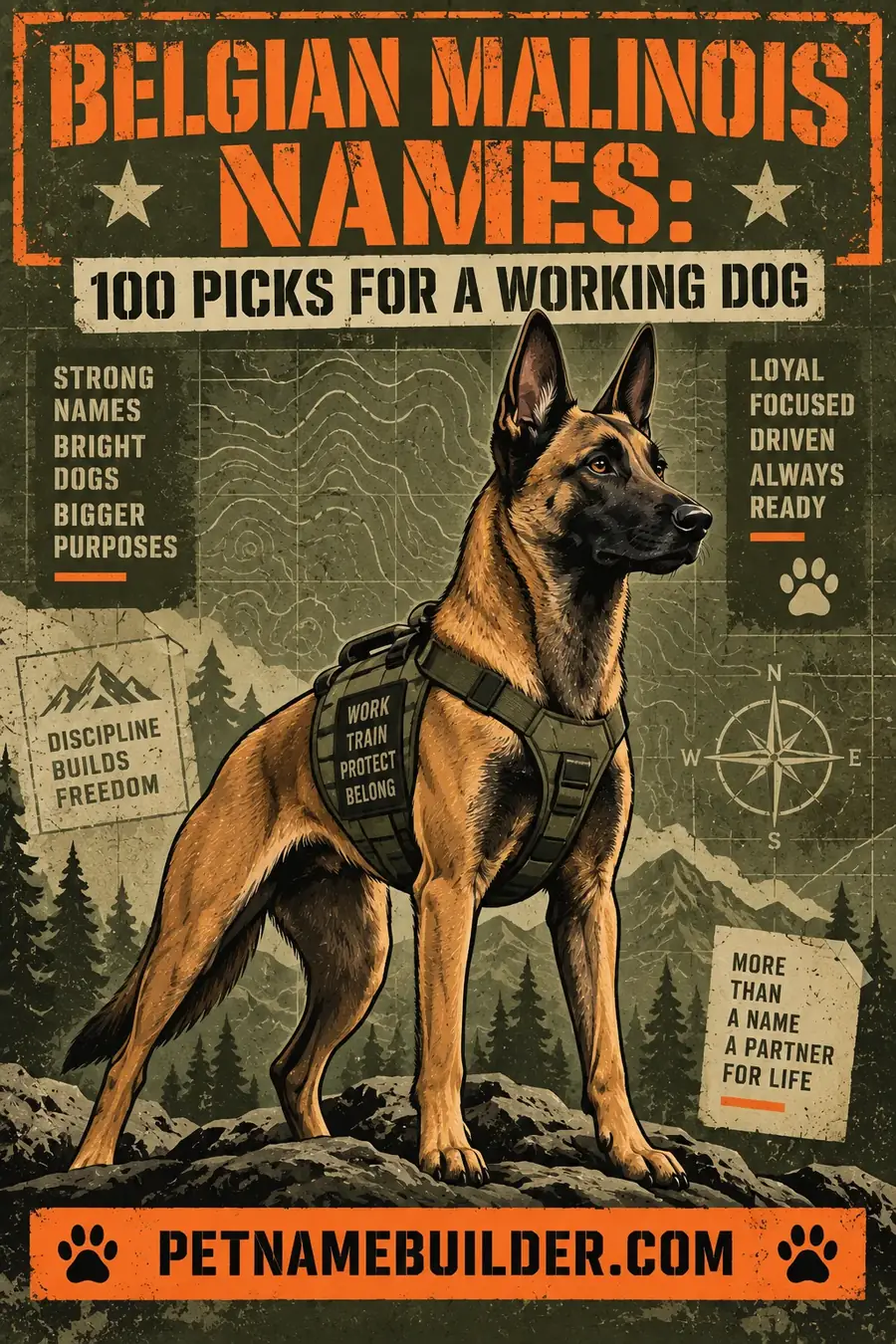
The Malinois is a working dog first, and the name should reflect the reality that this is a breed where recall genuinely matters — short, sharp, and impossible to confuse with a command. This is not a breed where a four-syllable name survives contact with real life.
Names below lean Belgian, Dutch, German and functional, which suits both the breed's origin and the work most of them do.
Belgian and Dutch Origin
The breed comes from Malines (Mechelen) in Belgium, and Dutch and Flemish names fit naturally.
Bram, Cato, Daan, Dries, Fenna, Gilles, Hendrik, Jasper, Joke, Klaas, Lars, Lieve, Lotte, Luuk, Maarten, Merel, Niels, Pieter, Roos, Sander, Sofie, Stijn, Thijs, Tycho, Vera, Wout.
German and Working-Line
Malinois are often trained alongside German shepherds and share much of that working vocabulary.
Arko, Asko, Balu, Bodo, Cliff, Dax, Ellu, Falko, Gero, Hasso, Iko, Jago, Kira, Lex, Nero, Ondra, Quando, Rex, Sarge, Tell, Ulf, Vito, Xanto, Yoschi, Zorro.
Military and K9 Style
Ammo, Arrow, Axel, Blitz, Bolt, Bravo, Chase, Chief, Cobra, Dagger, Delta, Diesel, Echo, Falcon, Flash, Ghost, Hunter, Jet, Kilo, Maverick, Onyx, Ranger, Recon, Rebel, Rogue, Saber, Scout, Sentry, Sniper, Storm, Striker, Tank, Titan, Tracker, Viper, Zulu.
Short and Sharp
The most practical category for this breed specifically. One syllable, hard consonant, carries at distance.
Ace, Ash, Bane, Blaze, Cash, Colt, Dex, Dot, Duke, Fang, Flint, Fox, Gage, Hawk, Jax, Kane, Knox, Nash, Nix, Pax, Quest, Rip, Rook, Sage, Scar, Slate, Trek, Vex, Wolf, Zane.
Female Picks
Astra, Bex, Bree, Cleo, Delta, Echo, Freya, Hexe, Indy, Juno, Kira, Lyra, Mika, Nika, Nova, Onyx, Pixel, Quinn, Rain, Roxa, Saga, Sable, Tess, Vala, Vixen, Wren, Xena, Zara.
What This Breed Specifically Needs From a Name
One or two syllables, no more. Malinois are fast, driven and often working at distance. A name you can deliver in half a second is a functional requirement, not a preference.
A hard consonant at the start. K, D, T, G, B, X sounds cut through noise, distance and drive. Soft-start names get lost exactly when it matters.
Zero overlap with commands. Critical with a breed this responsive. Say the name aloud beside every cue you use — sit, down, stay, come, heel, out, platz, fuss, hier, aus, bleib if you train in German. A collision with a high-drive dog mid-task is a real safety issue.
Distinct from other dogs in the household or unit. If you have multiple working dogs, names must be acoustically distinct from each other, not just different words. Dax and Max fail this. Dax and Kira pass.
Something you can say calmly. A name that only sounds right shouted trains a dog to associate its name with high arousal — the opposite of what you want for a recall cue in a breed that arouses easily.
On German Command Words
If you train in German or Dutch, as many Malinois handlers do, cross-check the name against the actual command set, not just English cues. Common ones include sitz, platz, bleib, hier, fuss, aus, voran, braav. A name like Foss or Plotz will cause problems that an English-only check would miss entirely.
Naming a Working vs. Companion Malinois
For a working, sport or service dog: prioritize function completely. Short, hard, distinct. Registered names can be as elaborate as you like; the call name is a tool.
For a companion Malinois: you have more latitude, but not as much as with a lower-drive breed. This is still a dog that needs reliable recall in situations where it's moving fast and highly stimulated. The Belgian and Dutch lists give you something with character that still functions.
Registered vs. call name: many working dogs carry a long registered name from the breeder — often with a kennel prefix and a letter dictated by the litter — and a completely separate call name. If your dog came with a registered name you dislike, the call name is entirely yours to choose.
If you want a shortlist filtered by sex, coat or intended work rather than reading through the whole list, a dog name generator narrows it quickly. For other powerful working breeds there's also Cane Corso names.
More Names by Category
Single-syllable working names — the shape this breed benefits from most. Ace, Arc, Ash, Bane, Bolt, Brix, Cash, Cliff, Colt, Dax, Dex, Drift, Duke, Fang, Flint, Fox, Gage, Ghost, Hawk, Jet, Kane, Kilo, Knox, Lex, Nash, Nix, Onyx, Pax, Quest, Rex, Rip, Rook, Sage, Scar, Slate, Storm, Tank, Trek, Vex, Watt, Wolf, Zane.
Dutch and Flemish — fitting for a breed from Mechelen. Bram, Cato, Daan, Dries, Fenna, Gilles, Hendrik, Joke, Klaas, Lieve, Lotte, Luuk, Maarten, Merel, Niels, Pieter, Roos, Sander, Sofie, Stijn, Thijs, Tycho, Vera, Wout.
German working-line — common in the sport and protection world. Arko, Asko, Balu, Bodo, Falko, Gero, Hasso, Iko, Jago, Kira, Nero, Ondra, Quando, Sarge, Tell, Ulf, Vito, Xanto, Zorro.
Tactical and K9 — widely used in service and sport contexts. Ammo, Arrow, Axel, Blitz, Bravo, Chase, Chief, Cobra, Dagger, Delta, Echo, Falcon, Flash, Hunter, Maverick, Ranger, Recon, Rebel, Rogue, Saber, Scout, Sentry, Striker, Tracker, Viper, Zulu.
Female picks — the same acoustic requirements apply. Astra, Bex, Bree, Cleo, Delta, Echo, Freya, Indy, Juno, Kira, Lyra, Mika, Nika, Nova, Onyx, Pixel, Quinn, Rain, Roxa, Saga, Sable, Tess, Vala, Vixen, Wren, Xena, Zara.
Checking a Name Against Your Command Set
This matters more with a Malinois than with almost any other breed, because the dog is fast, driven and genuinely listening.
If you train in English, check against: sit, down, stay, come, heel, off, out, wait, place, drop, back, watch, leave it, quiet.
If you train in German, check against: sitz, platz, bleib, hier, fuss, aus, voran, braav, such, fass, nein. Names like Foss, Plotz, Vor or Nane will cause problems an English-only check would miss entirely.
If you train in Dutch, check against: zit, af, blijf, hier, volg, los, apport, stil.
The test: say the name immediately followed by each command, at speed and at volume. Listen for anything that blurs. A dog that hesitates for even half a second between its name and a cue is a dog whose recall has a gap in it, and with this breed that gap has consequences.
Naming for Different Roles
Sport and protection work. Function completely dominates. Short, hard-onset, acoustically distinct from the command set and from every other dog on the field. Registered names can be as elaborate as the breeder liked; the call name is a tool.
Service and detection work. Same requirements, plus one more: the name will be used in public, sometimes in stressful settings, and occasionally by people other than the handler. Something clear and unremarkable serves better than something distinctive.
Companion Malinois. More latitude, but not unlimited. This is still a high-drive dog that needs reliable recall while moving fast and highly stimulated. The Dutch and Belgian lists give you character without sacrificing function.
Multi-dog households and kennels. Names must be distinct from each other acoustically, not merely different words. Dax and Max fail. Dax and Kira pass. This is the constraint people most often overlook when adding a second dog.
Living With the Name
A few practical points specific to a breed that's frequently working, frequently in public, and frequently handled by more than one person.
Everyone must say it identically. In a household with several handlers, or a kennel with several staff, variation in pronunciation means the dog is hearing several different cues. Agree the exact pronunciation and stick to it.
Keep it exclusively positive. If the name is ever used to interrupt or correct — "Dax, no!" — it acquires a negative association and recall degrades measurably. Use a separate interrupter sound and reserve the name for good things.
Short enough to repeat. In a genuine emergency, handlers repeat the name. One syllable repeats cleanly and urgently; three syllables don't.
Distinct from other dogs on the field. In sport and working environments there are often several dogs within earshot. A name that's acoustically distinct from the others present matters more here than almost anywhere else.
Match the paperwork. Microchip, vet records, insurance and any certification should all carry the name you actually use. A dog with a formal registered name and an unrelated call name creates confusion at exactly the wrong moment.
A Shortlist Worth Starting From
Twelve that cover the range and all meet the breed's acoustic requirements.
Dax — one syllable, hard onset, no command overlap. Kira — bright, clear, widely used in working lines. Onyx — sharp, distinctive, suits a dark dog. Bram — Dutch, short, a nod to the breed's origin. Nero — two syllables, strong, common in working pedigrees. Jet — one syllable, fast to say, very clear. Saga — female, bright ending, distinct from any cue. Lex — hard consonant, one syllable, maximum clarity. Tycho — Dutch, uncommon, easy to project. Vala — female, short, acoustically clean. Knox — hard, blunt, excellent under pressure. Nika — bright, short, works across languages.
A Note on the Breed
Worth saying plainly, since naming articles rarely do: the Malinois is not a breed for most households. It is a high-drive working dog bred for sustained physical and mental work, and without a genuine outlet for that drive it becomes destructive and difficult in ways that are hard to reverse.
If you're choosing a name because you've just committed to one of these dogs, the name is the easy part. The considerably harder part is the daily structured work the dog needs, every day, for a decade or more. Plenty of Malinois end up in rescue for exactly this reason.
None of which is an argument against the breed for the right home — they're extraordinary dogs for people equipped to work them. It's simply worth stating in a place where someone might be reading about names before they've thought through the rest.
Naming Conventions in Working Lines
If your dog comes from a working or sport pedigree, a few conventions are worth understanding.
Litter letters. Many European working kennels name every puppy in a litter with the same initial, assigned sequentially — an A litter, then a B litter, and so on. It's why working pedigrees contain so many dogs with matching first letters, and why a breeder may ask that the registered name begins with a particular letter.
Kennel affixes. The registered name usually carries the kennel's name as a prefix or suffix, identifying the breeder in the pedigree permanently.
Registered vs. call name. The registered name might be several words long. The call name is entirely separate and entirely yours. Many handlers pull one syllable out of the registered name; plenty ignore it completely.
Titles. In sport, dogs accumulate titles that get recorded before or after the registered name. None of this affects what you call the dog at home.
If you're taking on an adult working dog, it will usually arrive with an established call name. Changing it is possible but rarely worth the disruption for a dog whose recall is already trained to a specific sound.
Names for Other Working Breeds
Most of what applies to a Malinois applies to any breed that was built to take direction at distance, and the same short, hard-consonant names do the work.
Dog names for australian cattle dogs are the closest neighbor to this list. The breed was developed to move cattle across long distances in Queensland, and it needs exactly what a Malinois needs: a one or two-syllable name that cuts through wind and livestock noise. Names drawn from the breed's own origins fit well - Dingo, Bluey, Banjo, Coolabah, Waltz, Bindi, Kelpie, Digger, Matilda, Jarrah, Boomer, Nulla. So do the plain working names: Blue, Ace, Scout, Tucker, Dash, Bandit, Ridge, Gus.
The coat gives you an extra route here that a Malinois does not have. Cattle dogs are born white and darken into either a blue mottled or a red speckled adult coat, so Ash, Speckle, Cinder, Rusty, and Sable all describe something real about the dog.
The same shortlist logic covers Dutch Shepherds, German Shepherds, working Border Collies, and herding-line Aussies. Keep it under two syllables, keep the first sound hard, and keep it clearly distinct from every command word you intend to use.
Frequently Asked Questions
What makes a good name for a Belgian Malinois? One or two syllables, a hard consonant at the start, and no acoustic overlap with any command you use. This is a fast, high-drive breed where recall reliability has real safety implications.
Should a Malinois name be in Dutch or German? Not required, but it fits the breed's Belgian origin and the working lines many Malinois come from. If you train using German or Dutch commands, check your chosen name against those cues specifically rather than only English ones.
Can I change the name my Malinois came with? Yes. Many working dogs have a formal registered name from the breeder and a separate call name used day to day. Changing a call name is straightforward, particularly with a young dog.
Why do so many working dog names sound similar? Because they're selected for the same acoustic properties — short, hard-consonant, distinct from commands. That's convergence on what works rather than a lack of imagination.