Blue Heeler Dog Names: 150 Ideas for Australian Cattle Dogs
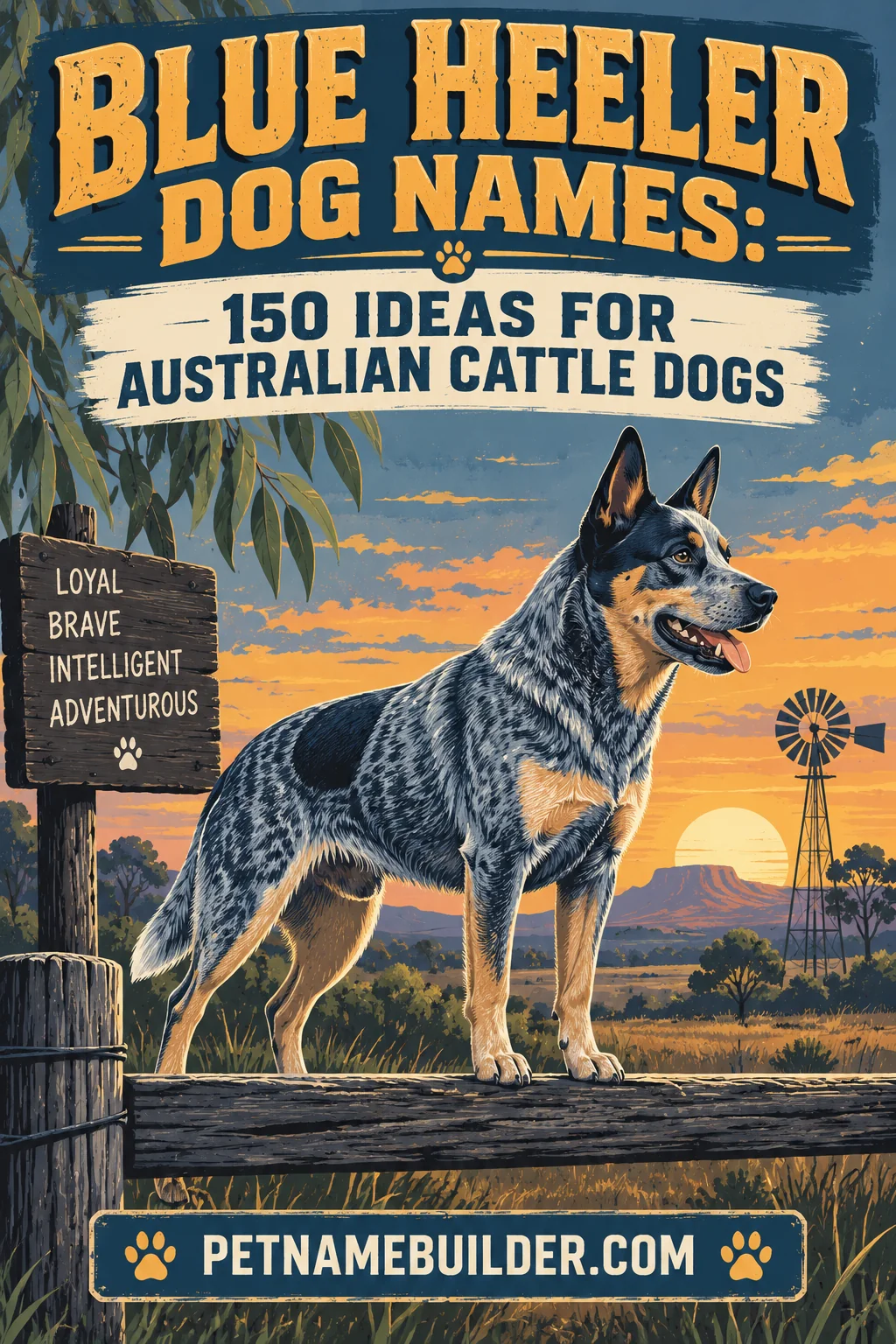
The best Blue Heeler names are short, hard-edged and Australian, because that is exactly what the dog is. This breed was built to move cattle across open country on a stockman's whistle, and a name that gets lost in wind and distance is a name you will regret by the third week.
Everything below carries a meaning or a reason. Some come from the breed's own history in the Queensland droving trade, some from the blue mottle and red speckle of the coat, and some are simply built to be shouted.
Why the Breed's Story Belongs in the Name
The Australian Cattle Dog was developed in the 1800s to move half-wild cattle over enormous distances, in heat that broke the imported British herding dogs. Thomas Hall crossed working droving dogs with the dingo, and the resulting Hall's Heelers stayed largely inside his family's stations until his death around 1870, after which the dogs spread. Later breeders in New South Wales and Queensland refined them, and Robert Kaleski drew up an early written standard in 1903.
That history hands you a specific naming well: droving vocabulary, station life, Queensland and Northern Territory geography, and the dingo itself. A heeler called Drover or Barcoo says something a heeler called Bella does not.
Temperament matters too. These dogs run high-drive, extremely biddable with their own person, reserved with strangers, and hardwired to nip at heels. That is the "heeler" in the name.
Blue Heeler Dog Names Female
Female heelers tend to run a touch smaller and often a touch sharper about strangers. These thirty lean Australian, with coat references mixed in.
| Name | Meaning / Origin | Why it fits |
|---|---|---|
| Matilda | Swagman's bedroll, from Waltzing Matilda | Peak Australian; shortens to Tilly |
| Alice | Alice Springs, near the country's center | Warm and easy to call |
| Bindi | Prickly burr in Australian lawns | Sharp, like a dog underfoot |
| Kylie | Australian name, also a curved throwing stick | Bright ending, cuts noise |
| Sheila | Australian slang for a woman | Cheeky and unmistakably local |
| Tilly | Short form of Matilda | Two crisp syllables for recall |
| Kimberley | Cattle country of northwest Australia | Big name; Kim in the paddock |
| Katherine | Northern Territory town and river | Traditional; shortens to Kat |
| Ruby | The deep red gemstone | Ideal for a red-speckled female |
| Sapphire | Gem mined in central Queensland | Blue coat, real Australian ground |
| Opal | Australia's gemstone, mined at Coober Pedy | Flecked blue-gray, like the coat |
| Pearl | Broome's pearling trade, northwest coast | Pale, pretty, one clean syllable |
| Wattle | Golden acacia, Australia's floral emblem | One syllable, hard finish |
| Waratah | Red flowering emblem of New South Wales | Striking on a red coat |
| Acacia | Genus behind wattle and mulga | Gentle name, intense dog |
| Daintree | Rainforest of far north Queensland | Distinctive, bright ending |
| Roo | From kangaroo | One syllable, carries through wind |
| Bonnie | Cheerful or pretty | Warm counterweight to a serious breed |
| Dusty | What a station dog looks like | Honest and instantly usable |
| Storm | Weather name | Suits a dog that arrives all at once |
| Misty | The pale wash over blue mottle | Descriptive without being fussy |
| Freckle | The speckling itself | Affectionate and literal |
| Ash | Gray ash color, and the tree | Hard finish, no command collision |
| Indi | The Indi River, Victoria's high country | Modern, bright, quick |
| Nellie | Victorian-era name that traveled with settlers | Reads like an old farm dog |
| Millie | Short for Millicent | Soft and quick for a small female |
| Coral | The reef off the Queensland coast | Pretty, and a soft red |
| Saltbush | Silver-gray scrub of the dry inland | Describes a blue coat; call her Salty |
| Blossom | Long-standing farm stock name | Gently ironic on a dog this driven |
| Mallee | Low eucalypt scrub of southern Australia | Distinct from every command |
Blue Heeler Names Male
Males run larger and often steadier. These blue heeler names male lean into droving work, the breed's founders, and the color of the coat.
| Name | Meaning / Origin | Why it fits |
|---|---|---|
| Bluey | Australian nickname for the color and breed | The default, and it never sounds wrong |
| Banjo | Banjo Paterson, who wrote Waltzing Matilda | Australian, and great to shout |
| Clancy | Clancy of the Overflow, Paterson's drover | Sounds like a station dog |
| Digger | Australian term for a soldier | Hard consonants front and back |
| Mack | Blunt and plain | Cuts across an open paddock |
| Drover | Men who walked cattle overland for months | The breed's original job |
| Ringer | Station slang for the best worker in the shed | Praise built into the name |
| Jackaroo | A young man learning station work | Shortens to Jack, which you will use |
| Boomer | An adult male kangaroo | Big, bouncing, unmistakable |
| Jarrah | Dark red hardwood eucalypt of Western Australia | Perfect for a red heeler |
| Mulga | Tough inland acacia; also the back country | No soft edges |
| Coolibah | The eucalypt in Waltzing Matilda's opening line | Long, but shortens to Coolie |
| Barcoo | Queensland river in droving country | Ends on a carrying vowel |
| Cooper | Cooper Creek, inland channel country | Natural-sounding, genuinely specific |
| Flinders | Ranges and river named for Matthew Flinders | Solid; Flint for short |
| Darwin | The Northern Territory capital | Recognizable, easy on the ear |
| Broome | Pearling town on the northwest coast | One long carrying vowel |
| Cairns | Far north Queensland port | Short, hard, clean finish |
| Hall | Thomas Hall, whose heelers founded the breed | The most historically accurate choice |
| Bentley | The white forehead star is the Bentley mark | Better still if your dog has one |
| Slate | Blue-gray stone | The coat in one syllable |
| Flint | Hard gray stone that strikes sparks | Sound and meaning both fit |
| Pewter | Dull blue-gray metal | Unusual and accurate |
| Cobalt | Deep blue pigment and mineral | Sharp opening, strong finish |
| Swagman | The wanderer of Waltzing Matilda | Becomes Swaggie, which suits a scruff |
| Bore | The artesian bore that waters inland stock | Plain station vocabulary |
| Yard | The stockyard where the dog works | About as blunt as names get |
| Bullock | A working ox, and the cattle themselves | Heavy name, heavy dog |
| Nugget | Gold lump; old slang for a short strong worker | A compliment disguised as a name |
| Kelpie | Australia's other great working breed | A nod to the trade |
Australian Cattle Dog Names From the Droving Country
These australian cattle dog names come out of station life, the breed's development, and the country the dogs actually worked.
| Name | Meaning / Origin | Why it fits |
|---|---|---|
| Queenie | The breed's old name was Queensland Heeler | History and warmth together |
| Kaleski | Robert Kaleski, who set an early standard in 1903 | Unusual and genuinely part of the story |
| Bagust | Sydney brothers who refined the early heelers | Only heeler people will catch it |
| Timmins | Jack Timmins, of the line called Timmins Biters | Fitting for a dog that nips |
| Dingo | Wild dog crossed into the breed's foundation | Two hard syllables, total accuracy |
| Elliott | George Elliott, early Queensland breeder | Ordinary sound, real provenance |
| Overlander | Drovers who moved cattle across the continent | Grand; shortens to Lander |
| Stockman | The mounted worker the dog runs beside | Says the job out loud |
| Muster | The round-up itself | One tight word |
| Boundary | Boundary riders checked fences alone for weeks | For an independent dog; Bounds for short |
| Paddock | The fenced run holding stock | Plain, punchy, very Australian |
| Station | An Australian cattle ranch | Simple and evocative |
| Homestead | The main house on a station | Warm; shortens to Stead |
| Outback | The dry interior | Blunt in the best way |
| Bushie | Someone at home in the bush | Affectionate slang, bright ending |
| Swag | The bedroll a drover carried | No wasted sound |
| Billy | Tin can boiled over a campfire for tea | Friendly and authentically bush |
| Damper | Soda bread baked in campfire coals | Homely and a little funny |
| Tucker | Australian word for food | Everyone remembers this one |
| Smoko | The mid-morning break from work | Cheerful, carrying O |
| Brumby | A feral horse of the inland | Wild energy, easy to shout |
| Gidgee | Inland acacia known for its scent after rain | Short, odd, memorable |
| Spinifex | Spiky desert grass of the interior | Prickly dog, prickly name; Spinny for short |
| Nullarbor | The treeless plain; Latin for no trees | Empty country in one word |
| Pilbara | Red iron-ore country of Western Australia | Made for a red heeler |
| Tanami | Desert crossing in the Northern Territory | Rolls well, stays uncommon |
| Birdsville | Town at the end of the far southwest Queensland track | Remote, specific, fond |
| Longreach | Central Queensland town at the heart of droving | Sounds like what the dog does |
| Winton | Queensland town where Waltzing Matilda was first performed | Short, hard T, easy recall |
| Charleville | Outback Queensland town on the Warrego River | Elegant name, rough dog |
Red Heeler Names for the Red Speckle Coat
Same breed, other accepted color. The red speckle is not a separate breed, and these red heeler names all point at that rust-and-earth coloring.
| Name | Meaning / Origin | Why it fits |
|---|---|---|
| Rusty | Oxidized iron | The default, and it still works |
| Copper | The reddish metal | Warm and carries fine |
| Ochre | Natural red-earth pigment | Matches red inland soil exactly |
| Ginger | The root and the hair color | Friendly, instantly understood |
| Cinnamon | Warm red-brown spice | Softer option for a female |
| Sorrel | Reddish-brown coat color in horses | Borrowed from station stock talk |
| Chestnut | Red-brown nut and horse color | Classic and specific |
| Auburn | Reddish-brown, usually of hair | Understated and slightly elegant |
| Blaze | A bright flame, and a facial marking | Fast name, fast dog |
| Rufus | Latin for red-haired | Old, real, pleasingly blunt |
| Ember | A glowing coal | Quiet name with heat behind it |
| Clay | Red earth | One syllable, hard ending |
| Brick | Fired red clay | Solid, no nonsense |
| Terra | From terracotta, fired red earth | Short and easy to call |
| Sienna | Red-brown earth pigment | Pretty without being fragile |
| Henna | The reddish plant dye | Two clean syllables |
| Paprika | Red pepper spice | Playful; becomes Pap or Rika |
| Foxy | For the red fox | Suits a sly, quick dog |
| Vixen | A female fox | Sharp name, sharp female |
| Cedar | Reddish aromatic timber | Calm and woody |
| Bronze | The red-gold alloy | Strong finish on the Z |
| Marmalade | The orange-red preserve | Long, but Maddie works |
| Redgum | Eucalypt with deep red timber | Australian and color-accurate |
| Simpson | Red sand dunes of the Simpson Desert | Ordinary surname, extraordinary place |
| Scarlett | Bright red | Bold; shortens to Lettie |
Cattle Dog Puppy Names for an Eight-Week-Old
Heeler puppies are born white and develop their speckling over the following weeks, which drives half the list below. The rest come from what an eight-week-old heeler actually does, which is bite your ankles. These cattle dog puppy names are meant to grow into an adult dog.
| Name | Meaning / Origin | Why it fits |
|---|---|---|
| Snowy | Puppies arrive white; also the Snowy River | Ages well after the color comes in |
| Ghost | The pale birth coat | Short and a little dramatic |
| Chalk | White mineral | One syllable, hard K |
| Pip | A seed; something small | Tiny name, big carry |
| Nipper | Slang for a small child, and the behavior | Two meanings, both accurate |
| Bandit | The dark face mask many heelers wear | Marking and behavior at once |
| Mask | Black or tan patch over the eye | Blunt and descriptive |
| Patch | A distinct block of color | Simple, warm, easy to shout |
| Star | The Bentley mark on the forehead | Only right if your dog has one |
| Comet | A streak of light across the sky | For the one that never stops |
| Scout | One who goes ahead and reports back | Herding-adjacent, hard consonant |
| Rocket | Straight-line speed | Honest description of most heeler puppies |
| Zip | Quick movement | Among the shortest usable names |
| Tuck | To gather in, as a dog gathers stock | Working word, tight sound |
| Bolt | To run suddenly | Fast to say when it matters |
| Poddy | A hand-reared calf on a station | Exactly right for a bottle-stage animal |
| Weaner | A calf just off its mother | Station word for a new arrival |
| Cub | A young animal | Soft but not silly |
| Sprocket | Toothed wheel that drives a chain | Mechanical and busy, like the dog |
| Ankle | The part of you the puppy targets | Everyone gets the joke |
| Turbo | Forced induction, more power | Ridiculous and fully deserved |
| Missy | Short for mischief | For a female with obvious intentions |
| Ratbag | Australian slang for a likeable rascal | Affectionate insult, the best kind |
| Tinker | One who fiddles with everything | Describes the puppy's view of your house |
| Rowdy | Loud and boisterous | Sets expectations honestly |
Short, Hard Names Carry Across a Paddock
This matters more with a heeler than with most breeds, because you will genuinely need to call this dog off something at distance.
Hard consonants punch through wind. K, T, P, D and B all cut. Soft sounds like L, M, W and S wash out over fifty yards of open ground. Bright vowels help too, so Mack projects better than Mook and Kip beats Coop. Two syllables is the practical maximum for a name you shout, and anything longer gets clipped anyway. Choose the clipped version deliberately rather than discovering it.
| Name | Meaning / Origin | Why it fits |
|---|---|---|
| Blue | The coat color and the breed's nickname | Never needs explaining |
| Kip | A short sleep | Hard K opening, hard P close |
| Gus | Short for Angus, a cattle breed | Blunt, warm, unmistakable |
| Dex | From Dexter, a small hardy cattle breed | Sharp X ending that carries |
| Tex | For cattle country abroad | Hard consonants, bright vowel |
| Rip | A sudden tear; a strong ocean current | About as fast as a name gets |
| Jet | Black stone, and speed | Clean and abrupt |
| Duke | A rank of nobility | Old farm dog name that still projects |
| Chip | A small fragment | Cheerful and quick |
| Buck | A male animal; to throw a rider | Hard both ends, station-appropriate |
| Zeb | Short for Zebedee | Uncommon, and the Z gives it edge |
| Nash | English surname meaning at the ash tree | Sharp finish, no command collision |
If you would rather filter a long list by size, coat color or sound shape than read straight through, a pet name generator narrows it faster than scrolling.
Names to Avoid With a Heeler
Anything that sounds like a command. Kit blurs into sit, Bo into no, Dana into down, Ray into stay. With a breed this responsive, hesitation costs you.
Names opening on a soft vowel. Ollie, Ava and Ellie are lovely, and they die in the wind. If you work this dog outdoors, weight the choice toward a hard opening.
Anything you would be embarrassed to yell. You will shout this name in a public park, at volume, more than once.
Rhyming names in the same house. If you already have a Bluey, do not add a Louie. Heelers read tone and shape, and near-identical names cause real confusion.
The Registered Name and the Name You Actually Use
If your heeler came from a breeder with papers, you already have two names, and it helps to treat them as separate jobs. The registered name is the one on the pedigree, and it usually opens with the breeder's kennel prefix followed by whatever they or you added to it. Registries cap the length and will not accept a name already in use in the breed, so these run long and formal: a prefix, something from the litter's theme, and a word of yours. It appears on paperwork, in a show catalog, and almost nowhere else.
The call name is the one you shout in the yard. It does not have to appear inside the registered name at all, though most owners pull it from there so the two stay connected. Pick the call name on sound, using the tests further up this page, and let the registered name be as elaborate as the breeder wants it.
Then there is a third version nobody plans for: the name on file. Your vet's practice software, the microchip registry, the pet insurance policy and the boarding kennel's whiteboard all store something, and they rarely store the same thing. Give every one of them the call name, spelled the way you would spell it to a stranger on the phone, and put the registered name only where it is actually required. If you change the call name in the first month, call the microchip registry as well as the vet. A chip that comes back under a name nobody in the house uses is a small problem that only shows up on the worst possible day.
Teaching a Heeler Its Name Without Wearing It Out
A name is not a command. It is a marker meaning look at me, something is about to happen, and the fastest way to break it is to spend it on nothing. With a breed this attentive, that happens quickly.
Start by paying it. Say the name once in a quiet room, and the instant the dog's head turns, feed something good. Twenty repetitions a day for a week, in short bursts, builds a dog who spins around at the sound before he has consciously decided anything. Say it once, not four times. A name repeated into silence teaches the dog that the first three were optional.
Keep it out of your corrections. If the name arrives just before the dog gets hauled off the couch, dragged away from something interesting, or shouted at, it starts to predict losing rather than gaining, and a smart breed makes that connection in days. Use "off," "leave it" or "eh-eh" for the interruption and keep the name clean.
It also helps to separate the name from your recall. The name buys attention. The recall word buys the whole dog. Plenty of heeler owners run a distinct recall cue, often a two-note whistle, that only ever means high value: cheese, a tug, a chance to work. Because it never gets used for anything dull, it never wears out, and the name can be used freely all day without spending the one signal you actually need at a road edge.
Naming a Second Heeler
Heelers often arrive in pairs, and the second name is a harder problem than the first, because the two have to be told apart at fifty yards by a dog who is already moving.
Change more than the first letter. Bluey and Louie start differently and still blur, because the vowel shape and the stress pattern are identical. What actually separates two names is rhythm: one blunt single-syllable name and one two-syllable name with the weight on the back beat, something like Mack and Barcoo. That pair cannot be confused even shouted into wind.
Check that neither name sits inside the other. Kip and Skip are the same word to a dog, and so are Nell and Nella. Two names differing only in their final consonant have the same trouble.
Give the pair a group word as well. Something like "dogs" or "both" tells them they are all being called, so you are not shouting two names in sequence while the second one takes the pause as permission to stay put. Teach it exactly the way you taught each name, with both dogs present and both paid.
Littermates deserve one extra thought. Raised together, they are slower to respond to their own names because so much of their attention is on each other, so make the two names as unalike as you can stand, and spend the first few weeks calling and rewarding them one at a time with the other one held.
Frequently Asked Questions
Is a Blue Heeler the same as an Australian Cattle Dog? Yes. Australian Cattle Dog is the formal breed name, and Blue Heeler refers to the blue-speckled color variant. Queensland Heeler is an older regional name for the same dog.
What is the Bentley mark on a Blue Heeler? It is a small white star or patch on the forehead, seen in many heelers. Breed lore ties it to a dog owned by a man named Tom Bentley, though that story is traditional rather than documented. The marking has no bearing on temperament or working ability.
Why are Blue Heeler puppies born white? The white birth coat is a normal feature of the breed, inherited from its foundation stock. Blue or red speckling develops over the first few weeks, so a litter that looks uniformly white at birth will not stay that way.
Should a working Blue Heeler have a shorter name than a pet? It helps. A one- or two-syllable name with a hard consonant carries across open ground and through wind far better than a long soft one. For a house companion the constraint matters much less, and you can choose on meaning alone.