Famous Dogs in History: Balto, Hachiko, Laika, Stubby and the Dogs Behind the Names

The most famous dogs in history are remembered for real events you can still check in museum records: Balto, who led the final leg of the 1925 diphtheria serum run to Nome, Alaska; Hachiko, the Akita who kept going to Shibuya Station for years after his owner died; Laika, the first animal to orbit Earth in 1957; Sergeant Stubby, the stray who served with American troops in World War I; and Owney, the postal dog who collected more than a thousand tags riding the mail trains. Each of them turned an ordinary dog's name into a word people still recognize.
This guide tells their stories using museum, university, NASA and U.S. Army sources, with exact dates where those sources give them. It also looks at where each name came from, separates legend from record, and ends with ideas for borrowing a historic name for your own dog.
🐾 Pick a name from this list
Tap Next for a name from this page, and save the ones you love.
Famous Dogs in History at a Glance
| Dog | Era | Where | Why we remember the name |
|---|---|---|---|
| Owney | From 1888 | Albany, New York, and the U.S. mail routes | Rode the mail trains and became the Railway Mail Service's mascot |
| Sergeant Stubby | 1917 to 1926 | Connecticut and France | Served with the 102nd Infantry in World War I |
| Hachiko | 1923 to 1935 | Tokyo, Japan | Waited at Shibuya Station for years after his owner died |
| Togo | 1925 | Alaska | Ran the longest stretch of the serum relay |
| Balto | 1925 to 1933 | Alaska and Cleveland, Ohio | Led the final leg of the serum relay into Nome |
| Fala | 1940 to 1952 | Washington, D.C., and Hyde Park, New York | Franklin Roosevelt's constant companion |
| Laika | 1957 | Soviet Union, Earth orbit | First animal to orbit Earth, aboard Sputnik 2 |
| Belka and Strelka | 1960 | Soviet Union, Earth orbit | Orbited Earth and came home safely |
Owney, the Railway Mail Dog
Owney's story starts in 1888 at the post office in Albany, New York. According to the Smithsonian's National Postal Museum, a stray mutt began hanging around the post office, and the clerks let him stay. He started riding along on mail wagons, then on mail trains, and before long he was traveling the country with the Railway Mail Service.
Railway mail clerks treated Owney as their unofficial mascot. As he moved from town to town, clerks marked his visits by adding medals and tags to his collar. He eventually collected more than a thousand of them, so many that Postmaster General John Wanamaker had a special harness made so the tags could be spread across the dog's body instead of weighing down his neck.
Owney's end is less clear. The museum's account says he was shot and killed in Toledo, Ohio, and different Smithsonian sources describe the circumstances differently. In 1911, the Post Office Department transferred Owney's preserved body to the Smithsonian, and he's on display at the National Postal Museum today.
What's in the name
Here's an honest answer: nobody seems to know. The museum's account suggests his original owner was probably a postal clerk who let the dog follow him to work, but the reason for the name itself isn't recorded. What we do know is that the name became shorthand for the whole Railway Mail Service, and that's a remarkable legacy for a stray.
Sergeant Stubby, the World War I Dog
Sergeant Stubby is America's best-known dog of World War I. The story begins in 1917, when a stray wandered onto the training grounds at Yale Field in New Haven, Connecticut, where the 102nd Infantry Regiment of the Connecticut National Guard was preparing for war. A soldier named J. Robert Conroy adopted him, and members of the unit smuggled the dog to France, as described in a 2026 U.S. Army article on a new Stubby statue.
How Stubby got his name
The Smithsonian's National Museum of American History describes Stubby as a brindle puppy with a short tail when Conroy befriended him at Yale in 1917. The name fits that description: a short, stubby tail made for an easy nickname that stuck. Brindle, by the way, is the striped coat pattern you see on many terrier mixes and boxers; if you have a striped pup of your own, our brindle dog names list is full of ideas.
What Stubby did
Stubby became the mascot of the 102nd Infantry, part of the 26th "Yankee" Division. According to the Army, he served through 17 engagements, alerted troops to gas attacks, located wounded soldiers and captured a German soldier. Another Army article on the Army's K-9 history adds that he survived a gas attack and an exploding grenade, and returned home after 18 months of war.
Back home, Stubby led parades, appeared at war bond rallies, and met Presidents Woodrow Wilson, Warren G. Harding and Calvin Coolidge. He died on April 4, 1926; the Army article marked the 100th anniversary of his death in April 2026. After his death, he was preserved, and Conroy donated him to the Smithsonian in 1956. On April 20, 2026, a new statue of Stubby was unveiled in Hartford, Connecticut, on the anniversary of the Battle of Seicheprey.
Was Stubby really a sergeant?
This is one of the most common questions about him. The Army's K-9 article says he was promoted to sergeant after capturing a German spy, while the Smithsonian describes the promotion as unofficial. In other words, "Sergeant" was a title his unit gave him, not a formal military rank. It stuck so well that "Sergeant Stubby" is now how nearly everyone knows him.
What breed was Stubby?
Sources disagree. The Army's 2026 article calls him a Boston terrier mutt, while other Smithsonian material describes him as a Staffordshire terrier mix. He was a stray, so nobody knows for certain. "Brindle mutt with a short tail" is the safest description.
Hachiko, the Most Loyal Dog
Hachiko is Japan's most famous dog and one of the best-known dogs in the world. The facts below come from Nippon.com's history of Hachiko and the University of Tokyo's own account.
The timeline
- November 1923: Hachi is born into a litter of Akita dogs in Odate, Akita Prefecture.
- January 1924: At about 50 days old, the puppy travels roughly 20 hours by train to Tokyo to live with Professor Hidesaburo Ueno of the university's agriculture faculty, whose home was near Shibuya Station.
- May 21, 1925: Professor Ueno dies suddenly of a cerebral hemorrhage at age 53, after a faculty meeting. Hachi had walked him to the station that morning as usual.
- 1932: A newspaper article by Saito Hirokichi tells Hachi's story, and he becomes famous across Japan.
- 1934: Volunteers raise funds for a bronze statue outside Shibuya Station, and Hachi attends its unveiling on April 21.
- March 8, 1935: Hachi dies at age 13.
- October 1944: The original statue is melted down for the war effort. It was rebuilt about three years after the war ended.
- March 8, 2015: The University of Tokyo holds the unveiling ceremony for a statue of Hachiko and Professor Ueno on its Yayoi campus, home of the Faculty of Agriculture, marking 80 years since Hachi's death.
How Hachiko got his name
This is one of the few famous dog names whose origin is clearly recorded. According to Nippon.com, Professor Ueno named the puppy Hachi because his front legs made the shape of the Japanese character 八, which means "eight" and is pronounced "hachi." The name Hachiko, with the added "ko," is an affectionate variation of that original name. So Japan's most famous dog was named for the way he stood. If you love the idea of a name with Japanese roots, our Japanese dog names list includes many more.
How long did Hachiko wait?
Different accounts give different numbers, and Nippon.com itself uses two. At the time of the 1932 newspaper story, Hachi had been waiting for seven years. By his death in 1935, the figure had become almost ten years. Simple math confirms the range: from May 1925 to March 1935 is just under ten years.
Where Hachiko is today
After a funeral on March 12, 1935, Hachi's remains were interred beside Professor Ueno's grave in Aoyama Cemetery in Tokyo. His preserved coat is displayed at the National Museum of Nature and Science in Tokyo, and the University of Tokyo notes that some of his internal organs are still kept on its Yayoi campus. The university adds that since 2016, Professor Ueno's partner, Yaeko, has rested with them in Aoyama Cemetery.
Balto and Togo: The 1925 Serum Run
In January 1925, the town of Nome, Alaska, faced an outbreak of diphtheria, a dangerous bacterial infection. Antitoxin serum was the treatment, but Nome was cut off by winter. The solution was a dog-sled relay. The facts below come from the Cleveland Museum of Natural History, which has cared for Balto's preserved body for decades.
| Date or figure | What happened |
|---|---|
| About January 20, 1925 | Nome's doctor identifies diphtheria cases |
| January 27, 1925 | The serum arrives by train at Nenana, the start of the sled relay |
| 674 miles | Total length of the journey to Nome |
| 20 mushers, more than 150 dogs | The teams that completed the relay |
| About 30 miles | Typical distance each team carried the serum |
| 91 miles | The longest stretch, run by Leonhard Seppala with lead dog Togo |
| 53 miles | The final stretch, run by Gunnar Kaasen with lead dog Balto |
| February 2, 1925 | Kaasen and Balto reach Nome early in the morning |
| 127 hours | Total time, about five and a half days, a record |
A quick check of the math: 674 miles split among 20 teams works out to an average of about 34 miles per team, which fits the museum's "about 30 miles" figure, with some teams running much more, like Seppala and Togo.
Balto's moment on the ice
The museum describes a key moment on the final leg. Crossing the Topkok River, Balto suddenly stopped because his paws had broken through the ice. By refusing to go on, he kept the team from plunging into the freezing water. Kaasen's team then completed the run into Nome.
Why Togo matters too
Balto became the star because his team brought the serum into Nome, and arrivals make headlines. But the longest stretch of the relay, 91 miles, belonged to Leonhard Seppala and his lead dog Togo, who crossed Norton Sound ahead of breaking ice. Today, many people remember both names, which is a fairer reflection of what happened. If you have a sled-dog breed at home, our husky dog names list has more cold-weather ideas.
From Alaska to Cleveland
After the relay, Balto toured with Kaasen and later ended up on display in poor conditions. A Cleveland businessman, George Kimble, started a campaign called the Balto Fund, and donations, many of them pennies, raised the money in 10 days. Balto and six surviving teammates arrived in Cleveland on March 19, 1927, to a parade through Public Square. Balto lived out his life there and died of natural causes in 1933. His preserved body is still displayed at the Cleveland Museum of Natural History.
Balto even helped modern science. The museum notes that his DNA contributed to studies published in the journal Science in 2023, part of a project that compared the genomes of 240 mammal species.
Fala, a President's Constant Companion
Fala, Franklin D. Roosevelt's Scottish terrier, is the most famous presidential dog. The National Park Service's article on Fala gives his full name as "Murray the Outlaw of Falahill," after a family ancestor. A National Archives photo shows the president with four-month-old Fala near Pine Plains, New York, on August 8, 1940.
Fala traveled with Roosevelt by ship and plane, appeared in an MGM documentary about White House life, and starred in Roosevelt's September 23, 1944, "Fala speech," in which the president joked that while he didn't resent political attacks, "Fala does resent them." The NPS also notes that soldiers reportedly used Fala's name as a password during World War II. After Roosevelt's death, Fala lived with Eleanor Roosevelt until he died in 1952. His bronze statue sits beside Roosevelt's at the FDR Memorial in Washington, D.C., the only presidential pet honored that way.
Laika and the Soviet Space Dogs
On November 3, 1957, less than a month after the first Sputnik, the Soviet Union launched Sputnik 2 with a dog named Laika aboard. NASA's history office calls her "the first animal to orbit the Earth."
Laika's story is a sad one. No plan existed to bring her back, and NASA notes that engineers hadn't designed the life-support system for a long mission. It's likely she survived only a few hours after reaching orbit. The satellite's batteries ran out on November 10, and Sputnik 2 burned up on re-entry on April 14, 1958.
Laika's other name
According to NASA's brief history of animals in space, Laika's real name was Kudryavka, which means "Little Curly." Laika is the name that went around the world.
The names of the space dogs
Laika wasn't the only Soviet space dog, and the others had charming names. NASA's history lists many of them, with English translations. Several came home safely.
| Name | Meaning | Flight details from NASA |
|---|---|---|
| Dezik and Tsygan | Tsygan means "Gypsy" | August 15, 1951; the first dogs on a suborbital flight, both recovered |
| Lisa | (no translation given) | Flew with Dezik in September 1951 |
| Smelaya | "Bold" | Listed among the early flight dogs |
| Malyshka | "Little One" | Listed among the early flight dogs |
| Albina, Dymka | "Whitey," "Smoky" | Listed among the flight dogs |
| Modnista, Kozyavka | "Fashionable," "Gnat" | Listed among the flight dogs |
| Bars and Lisichka | "Panther" or "Lynx," and "Little Fox" | Lost in a 1960 launch failure |
| Belka and Strelka | "Squirrel" and "Little Arrow" | Launched August 19, 1960, on Sputnik 5, and returned safely |
| Chernushka, Zvezdochka | "Blackie," "Little Star" | Flew in 1961 |
Notice how many of these names describe looks or personality: Whitey, Smoky, Blackie, Little Curly, Bold. That's exactly how many people still name dogs today. If the star-themed names appeal to you, our celestial pet names list carries on the theme.
Strelka's puppy and the White House
NASA adds a twist that links two famous-dog stories. After her flight, Strelka had a litter of six puppies, and one was given to President John F. Kennedy as a gift for his children. A space dog's daughter ended up as a White House pet during the Cold War.
Military Dogs After Stubby
Stubby was a mascot, not an officially trained working dog. Formal training came later. According to the Army's K-9 Corps history, the Army established the K-9 Corps in 1942, and more than 30,000 dogs have served in the U.S. military since then.
The same article mentions Cairo, a Belgian Malinois who went with Navy SEAL Team Six on the raid on Osama bin Laden's compound. Most modern military working dogs work quietly and are known mainly to their handlers, so names like Cairo that become public are the exception.
A Timeline of Famous Dogs in History
It helps to see these stories side by side, because several of them overlap in surprising ways. Hachi was born the same decade Balto ran into Nome, and Stubby died the year after the serum run. Here's the combined timeline, using the dates from the sources cited above.
- 1888: Owney turns up at the Albany, New York, post office.
- 1911: Owney is transferred to the Smithsonian.
- 1917: Stubby wanders onto Yale Field and is adopted by J. Robert Conroy of the 102nd Infantry.
- November 1923: Hachi is born in Odate, Japan.
- January 1924: Hachi arrives in Tokyo to live with Professor Ueno.
- January 27 to February 2, 1925: The serum relay carries diphtheria antitoxin from Nenana to Nome, with Togo running the longest leg and Balto leading the last one.
- May 21, 1925: Professor Ueno dies, and Hachi's long wait at Shibuya Station begins.
- April 4, 1926: Stubby dies.
- March 19, 1927: Balto and six teammates arrive in Cleveland.
- 1932: A newspaper article makes Hachi famous across Japan.
- 1933: Balto dies in Cleveland.
- April 21, 1934: Hachi attends the unveiling of his own statue at Shibuya Station.
- March 8, 1935: Hachi dies.
- August 8, 1940: Four-month-old Fala is photographed with Franklin Roosevelt.
- 1942: The U.S. Army establishes the K-9 Corps.
- September 23, 1944: Roosevelt gives the "Fala speech."
- October 1944: Hachi's original statue is melted down for the war effort.
- August 15, 1951: Dezik and Tsygan fly a suborbital flight and are recovered.
- 1952: Fala dies at Hyde Park.
- 1956: Stubby is donated to the Smithsonian.
- November 3, 1957: Laika is launched on Sputnik 2.
- April 14, 1958: Sputnik 2 burns up on re-entry.
- August 19, 1960: Belka and Strelka are launched on Sputnik 5 and return safely.
- March 8, 2015: The University of Tokyo unveils its Hachiko and Professor Ueno statue.
- 2023: Balto's DNA contributes to studies published in Science.
- April 20, 2026: A new statue of Stubby is unveiled in Connecticut.
Statues and Memorials You Can Visit
Part of the reason these names have lasted is that people built things to remember them. If you like to travel with history in mind, here's where the famous dogs in this guide are honored.
| Dog | Memorial | Detail from the sources |
|---|---|---|
| Hachiko | Bronze statue outside Shibuya Station, Tokyo | The first statue, 162 centimeters high, was unveiled in 1934 with Hachi present; it was melted down in 1944 and later rebuilt |
| Hachiko and Professor Ueno | Statue on the University of Tokyo's Yayoi campus | Unveiled March 8, 2015, marking 80 years since Hachi's death |
| Balto | Preserved mount and bronze statue, Cleveland Museum of Natural History | The museum describes a recently installed bronze statue near its Wade Oval entrance |
| Fala | Bronze statue at the Franklin Delano Roosevelt Memorial, Washington, D.C. | Sculptor Neil Estern added Fala beside the seated president |
| Sergeant Stubby | New statue in Hartford, Connecticut | Unveiled April 20, 2026, a century after his death |
| Owney | National Postal Museum, Washington, D.C. | His preserved body is displayed with his tags |
Notice the gap between when a dog lived and when some of these memorials appeared. Hachiko's university statue came 80 years after his death, and Stubby's new statue came 100 years after his. Good stories keep finding new audiences.
Where did the names Balto and Togo come from?
This is a fair question, and the museum sources we used don't answer it. The Cleveland Museum of Natural History explains what Balto did in great detail but doesn't say who named him or why. Rather than repeat stories we can't confirm, we'll leave it there. It's a good reminder that even very famous dogs often have names whose origins nobody wrote down at the time.
Sharing These Stories With Kids
Famous dog stories are a natural way to get children interested in history, geography and science. A few ideas:
- Map it. Trace the serum run from Nenana to Nome on a map of Alaska, or Hachi's train ride from Odate to Tokyo.
- Do the math together. Divide 674 miles by 20 teams, or count the years from 1925 to 1935, the way we did above.
- Pick gentler stories for younger kids. Owney's travels and Belka and Strelka's safe return are cheerful. Laika's story and the end of Hachi's wait are sad, so older children may be better able to handle them.
- Talk about names. Ask children why they think Stubby or Hachi got their names, then share the real reasons. It's a fun way to show how names can describe what someone sees.
Strays, Purebreds and Working Dogs
One of the nicest things about this group is how different their backgrounds were. Fame didn't depend on pedigree.
- Strays. Owney was a stray who adopted a post office. Stubby was a stray who adopted a regiment. Neither had a known breed or a planned name, yet both are now in Smithsonian collections.
- A purebred. Hachi came from a litter of Akita dogs and traveled to Tokyo to join a professor's household. His loyalty, not his breeding, made him famous.
- Working sled dogs. Balto and Togo were doing the job they were trained for. Their fame came from doing it under extreme pressure.
- A gift to a president. Fala came to Roosevelt as a puppy and became a public figure simply by being at the president's side.
- Program dogs. The Soviet space dogs were chosen and trained for flights. Their names were often simple descriptions of how they looked.
If you're adopting a mixed-breed dog with an unknown past, it's worth remembering that two of the most celebrated dogs in American history started out exactly that way.
Try It Yourself: A Quick Famous Dogs Quiz
Test what you've learned, or try these on your family at dinner. Answers follow each question.
- Which dog ran the longest leg of the 1925 serum relay? Togo, with musher Leonhard Seppala, covered 91 miles.
- What does the name Hachi refer to? The shape of the puppy's front legs, which looked like the Japanese character for "eight."
- What was Laika's real name, and what did it mean? Kudryavka, meaning "Little Curly."
- How many tags and medals did Owney collect? More than a thousand.
- Which three presidents did Stubby meet? Woodrow Wilson, Warren G. Harding and Calvin Coolidge.
- What were the names of the two dogs who orbited Earth on Sputnik 5 and came home? Belka ("Squirrel") and Strelka ("Little Arrow").
- What was Fala's full name? Murray the Outlaw of Falahill.
- Where can you see Balto today? At the Cleveland Museum of Natural History in Ohio.
If you got six or more, you know more about famous dogs than most people. If you missed a few, the stories above are worth a second read.
What These Famous Names Have in Common
Put these dogs side by side and a few patterns jump out.
- Short and easy to shout. Owney, Balto, Togo, Fala, Hachi and Laika are all two syllables. Stubby is too. Names that are quick to call tend to stick.
- Descriptive. Stubby was named for his tail, Hachi for his leg shape, and Kudryavka for her curls. Many of the space dogs' names describe color.
- A formal name hiding behind a short one. Fala's full name was Murray the Outlaw of Falahill. Hachiko is an affectionate form of Hachi.
- A title that the public added. "Sergeant" Stubby and "Hachiko" both show how admirers can add to a dog's name over time.
- Remembered through objects. Owney's tags, Stubby's preserved body, Balto's mount in Cleveland and Hachiko's statues all keep the names visible to new generations.
Legend Versus Record: Common Mix-Ups
Famous dogs attract myths. Here's how some popular claims line up against the sources.
- "Balto ran the whole way." No. The relay used 20 mushers and more than 150 dogs. Balto led the final 53 miles. Togo's team covered the longest stretch, 91 miles.
- "Stubby was an officially ranked sergeant." His promotion was unofficial, according to the Smithsonian. The title was an honor from his unit.
- "Hachiko waited exactly ten years." Accounts vary between seven years (in 1932) and almost ten years (by 1935).
- "Laika survived for days in orbit." NASA says she likely survived only a few hours, though some older accounts gave longer estimates.
- "Owney's death is fully documented." Smithsonian sources describe it differently, so the details remain uncertain.
- "Stubby was a pit bull." Breed descriptions vary, from Boston terrier mutt to Staffordshire terrier mix. He was a stray, so no one knows for sure.
Borrowing a Historic Name for Your Dog
Many people name their dogs after famous dogs from history, and it can be a lovely way to honor a story. A few tips help it go well.
- Know the story. Some stories, like Laika's, are sad. That doesn't mean you can't use the name, but it's worth knowing what you'll be explaining at the dog park.
- Match the dog when you can. A husky named Togo or Balto, an Akita named Hachi, or a brindle terrier mix named Stubby makes the connection easy for others to see.
- Use the short form. Like Fala and Hachi, the best everyday names are quick. Save the long version for the paperwork.
- Consider the meaning. Belka ("Squirrel") and Strelka ("Little Arrow") are delightful for a quick, small dog. Malyshka ("Little One") suits a tiny pup.
- Say it out loud. Call the name across a room a few times. If it's clear and distinct from your usual commands, it's a keeper.
A few historic names to consider
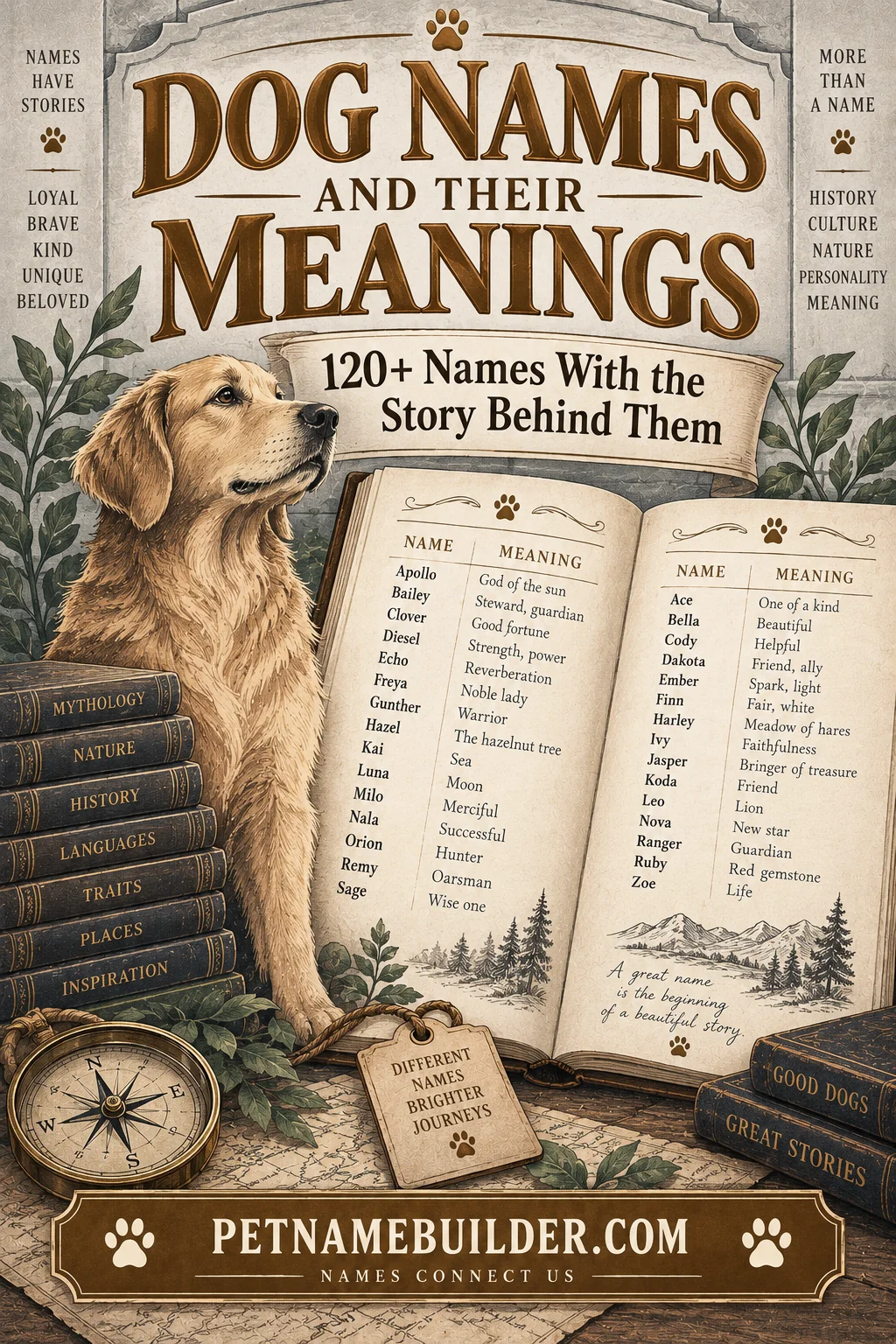
Here are some ideas pulled straight from the stories above, as illustrations: Owney for a well-traveled rescue, Togo for a hard-working sled breed, Hachi for a loyal Akita or Shiba, Strelka for a speedy little dog, and Zvezdochka (or just "Star") for a dog with a white blaze. For more names with a story behind them, see our dog names with meanings list, and for old-fashioned picks, try vintage pet names. If you want something that sounds as tough as Stubby, our strong dog names for male puppies list is a good place to look.
Why These Dogs Still Matter
Every one of these dogs was, at first, an ordinary animal: a stray at a post office, a stray at a training camp, a puppy on a train, a sled dog doing a hard job, a small dog chosen for a space program. What made them famous was a moment when people noticed what they did and cared enough to write it down, take a photograph, build a statue or preserve a body for a museum.
That's why their names have lasted. Balto, Hachiko, Laika and Stubby aren't just names anymore. They're short ways of saying "courage," "loyalty," "sacrifice" and "service." When you choose a name for your own dog, you're starting a much smaller story, but it's the same kind of story.
Find a Name With History Behind It
If these stories have you thinking about your own dog's name, try our free pet name finder. You can browse over a thousand names by personality, color and meaning, take a short quiz, and keep a list of favorites while you decide whether your pup is more of a Togo or a Hachi.
Where Each Famous Dog Got Its Name
This table puts the naming stories side by side, including the dogs whose name origins are not recorded in the sources.
| Dog | The name | Where it came from |
|---|---|---|
| Stubby | Sergeant Stubby | Named for his tail, and the "Sergeant" was an unofficial honor from his unit |
| Hachiko | Hachi, with an affectionate ending | Hachi refers to the shape of the puppy's front legs, which looked like the Japanese character for "eight" |
| Laika | Kudryavka was her real name | It means "Little Curly" |
| Fala | Murray the Outlaw of Falahill | A long formal name with the short call name taken from the end of Falahill |
| Belka and Strelka | "Squirrel" and "Little Arrow" | Names that describe the dogs, like many of the Soviet space dogs |
| Owney, Balto and Togo | Short, easy-to-shout names | The sources used here don't explain where these names came from |
Frequently Asked Questions
Who is the most famous dog in history?
There's no official answer, but a handful of dogs come up again and again. Hachiko is probably the best-known dog in Japan and is famous worldwide for his loyalty. Laika is famous as the first animal to orbit Earth, in 1957. Balto became a household name in the United States after the 1925 serum run to Nome, Alaska. Sergeant Stubby is the best-known American dog of World War I. Which one you'd pick depends on whether you value loyalty, bravery, science or service, and each has a museum or statue keeping the story alive.
Did Balto really save Nome?
Balto was one hero among many. The 1925 serum relay used 20 mushers and more than 150 dogs to carry diphtheria antitoxin 674 miles to Nome in about 127 hours, according to the Cleveland Museum of Natural History. Balto led Gunnar Kaasen's team on the final 53-mile leg and reached Nome early on February 2, 1925. He also stopped the team when his paws broke through ice on the Topkok River. The longest stretch, 91 miles, was run by Leonhard Seppala's team with lead dog Togo. Both dogs deserve credit.
How long did Hachiko wait for his owner?
Accounts vary, and even a single source can give two figures. Professor Hidesaburo Ueno died on May 21, 1925, and Hachiko died on March 8, 1935. Nippon.com says Hachi had been waiting for seven years when a 1932 newspaper article made him famous, and almost ten years by the time he died. The simple math from May 1925 to March 1935 is just under ten years. So the best short answer is that Hachiko kept going to Shibuya Station for nearly a decade after his owner's death.
Why was the dog named Hachiko?
According to Nippon.com, Professor Ueno named the puppy Hachi because his front legs made a shape like the Japanese character for eight, which is pronounced hachi. Hachiko is an affectionate variation of that original name, and it's the version the public came to use. That makes Hachiko one of the few famous dogs whose name origin is clearly recorded. He was an Akita, born in November 1923 in Odate, Akita Prefecture, and came to Tokyo in January 1924 when he was about 50 days old.
What happened to Laika the space dog?
Laika was launched aboard Sputnik 2 on November 3, 1957, becoming the first animal to orbit Earth, according to NASA. There was no plan to bring her back, and NASA notes the life-support system wasn't designed for a long mission. She likely survived only a few hours after reaching orbit. The spacecraft's batteries ran out on November 10, and Sputnik 2 burned up on re-entry on April 14, 1958. NASA also says her real name was Kudryavka, meaning Little Curly. Her flight helped pave the way for later missions that returned animals safely.
Was Sergeant Stubby a real sergeant?
Not officially. Stubby was a stray adopted in 1917 by J. Robert Conroy while the 102nd Infantry trained at Yale Field in Connecticut. He served with the unit in France through 17 engagements, according to the U.S. Army, alerting soldiers to gas, finding wounded men and capturing a German soldier. An Army article says he was promoted to sergeant, but the Smithsonian describes the promotion as unofficial. In other words, Sergeant was an honorary title from the soldiers who loved him. He died on April 4, 1926.
Where can you see famous dogs today?
Several are preserved or memorialized in museums. Balto's preserved body is displayed at the Cleveland Museum of Natural History in Ohio. Owney is on display at the Smithsonian's National Postal Museum in Washington, D.C. Stubby was donated to the Smithsonian in 1956. Hachiko's preserved coat is at the National Museum of Nature and Science in Tokyo, and statues of him stand at Shibuya Station and on the University of Tokyo's Yayoi campus. Fala's bronze statue sits beside Franklin Roosevelt's at the FDR Memorial in Washington, D.C.
What were the names of the dogs that went to space and came back?
NASA's history of animals in space lists several. Dezik and Tsygan flew a suborbital flight on August 15, 1951, and were both recovered. Belka, meaning Squirrel, and Strelka, meaning Little Arrow, orbited Earth on Sputnik 5, launched August 19, 1960, and returned safely. Chernushka, meaning Blackie, and Zvezdochka, meaning Little Star, flew in 1961. Sadly, not every flight ended well; Laika was never meant to return, and Bars and Lisichka were lost in a 1960 launch failure. Strelka later had six puppies, one of which went to President Kennedy.
Is it okay to name my dog after a famous dog?
Absolutely. Naming a dog after a historic one is a popular way to honor a story you love. Just know the story first, since some, like Laika's, are sad, and you'll likely be asked about the name. It helps when the name fits the dog, such as Togo for a husky or Hachi for an Akita. Short names are easiest for everyday use, so you might keep a long version for paperwork and call the dog by a quick one, the way Fala's full name was Murray the Outlaw of Falahill.
Sources
We checked every source below while writing this guide. Last reviewed October 30, 2026, by Joan Ramos.
- The Great Serum Run and Balto's Enduring Legacy (Cleveland Museum of Natural History)
- 60 Years Ago: The First Animal in Orbit (NASA History Office)
- A Brief History of Animals in Space (NASA History Office)
- Hachiko, the Faithful Dog (Nippon.com (Nippon Communications Foundation))
- Hachiko and UTokyo (part 1): The interwoven story of a dog, the University and various people (The University of Tokyo)
- Connecticut State Library Unveils New Sgt. Stubby Statue (U.S. Army)
- Army K-9 Corps: Man's best friend raises paw, serves too (U.S. Army)
- Stubby: Dog, Hoya mascot, and war hero (Smithsonian National Museum of American History)
- Owney (Smithsonian National Postal Museum)
- Fala (National Park Service)