Dog Commands in German: Words, Pronunciation and Why Handlers Use Them
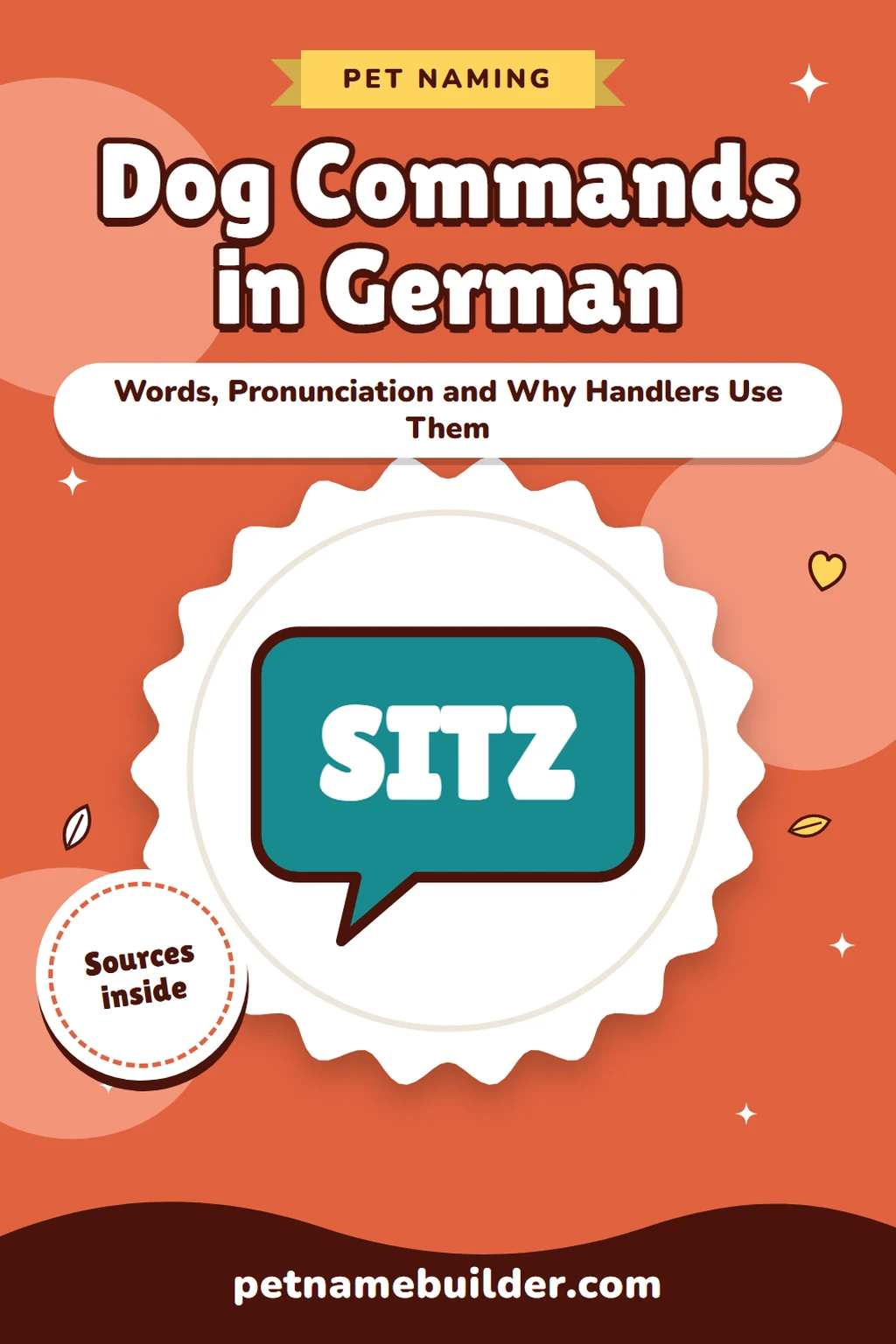
Dog commands in German are short, crisp words like Sitz (sit), Platz (down), Fuß (heel), Hier (come) and Aus (let go). Many working dog handlers and sport trainers use them, partly because of the German roots of dog sports like Schutzhund, and partly because German words don't pop up in everyday English conversation, so the dog hears its cue only when it's meant. Dogs don't understand German any better than English. They learn whatever sound you pair with an action, so German works as long as you're consistent.
This guide gives you a full list of common German commands with the correct spelling, a simple pronunciation and the meaning, plus the history behind the tradition, what the official IGP rules actually say about language, and what brain research tells us about how dogs process the languages they hear. We checked spellings and pronunciations against the DWDS (Digitales Wörterbuch der deutschen Sprache), a major German dictionary from the Berlin-Brandenburg Academy of Sciences.
The core dog commands in German
These are the everyday commands most German-trained dogs know. The pronunciation column uses plain English sounds, so you don't need to know phonetic symbols. Capital letters show the stressed syllable in words with more than one.
| English cue | German command | Say it like | Literal meaning |
|---|---|---|---|
| Sit | Sitz | "zits" | "Seat" or "sit" |
| Down | Platz | "plahts" | "Place" |
| Heel | Fuß (also written Fuss) | "fooss" | "Foot" |
| Stay | Bleib | "blipe" (rhymes with "type") | "Stay" (from bleiben, to remain) |
| Come | Hier | "heer" | "Here" |
| Come (alternative) | Komm | "kohm," with a short o | "Come" |
| Let go / drop it | Aus | "owss" (rhymes with "house") | "Out" |
| No / leave it | Pfui | "pfoo-ee," said quickly as one beat | An expression of disapproval, like "yuck" |
| No | Nein | "nine" | "No" |
| Stand | Steh | "shtay" | "Stand" (from stehen) |
| Good dog | Brav | "brahf" | "Well-behaved" |
| Good | Gut | "goot" | "Good" |
A few notes on these, with dictionary support:
- Platz. The DWDS lists "Platz!" specifically as a command to a dog to sit or lie down. In dog training, it's almost always used for "down." Its pronunciation is given as [plats].
- Fuß. The DWDS entry for Fuß lists "bei Fuß" as a fixed expression and gives the pronunciation [fuːs], a long "oo." The letter ß is called Eszett and sounds like "ss." If your keyboard doesn't have it, "Fuss" is the standard substitute.
- Pfui. The DWDS entry for pfui says it's used especially toward children and dogs as an urgent command to stop or not start a behavior. Its pronunciation is [pfʊɪ̯]. Make sure you sound the "p": it's "pf," not just "f."
- Komm. The DWDS entry for kommen lists "komm!" meaning "come here," with the stress on the first syllable of kommen, [ˈkɔmən].
- Brav. The DWDS entry for brav defines it as obedient and well-behaved, and even gives "ein braves Hundchen" (a good little dog) as an example.
- Aus. The dictionary pronunciation is [aʊ̯s], like the "ouse" in "house." In everyday German, "aus!" can mean "that's it, finished." Dog trainers use it to mean "let go of that."
Retrieve, search, jump and other working commands
Dogs trained for sport, hunting or police work learn a second layer of commands. These are the most common.
| English cue | German command | Say it like | Notes |
|---|---|---|---|
| Fetch / bring it | Bring | "bring," with a short i | Simple and common |
| Retrieve | Apport | "ah-PORT" | From apportieren, the hunting word for retrieving |
| Search / find it | Such | "zookh," with a throaty "kh" | From suchen, to search |
| Speak / bark | Gib Laut | "gip lowt" | Literally "give sound" |
| Jump | Hopp | "hop" | Used for jumps and climbing walls |
| Go out / send-away | Voraus | "for-OWSS" | Means "ahead" |
| Slow | Langsam | "LAHNG-zahm" | Useful on leash |
| Wait | Warte | "VAR-tuh" | From warten, to wait |
| Watch / be alert | Pass auf | "pahss OWF" | Literally "pay attention" |
More dictionary support:
- Apport. The DWDS entry for apportieren explains it as hunting language for a trained dog bringing back shot game or thrown objects. Its example: "der Hund apportiert den Hasen," the dog retrieves the hare.
- Gib Laut. The DWDS entry for Laut includes the hunting expression "der Hund gibt Laut," explained as "barks." So "Gib Laut!" literally means "Give voice!"
- Voraus. The DWDS defines voraus as being in front of someone or something, ahead. In obedience sport, it's the cue to run straight out ahead of the handler.
Everyday German phrases for family dogs
You don't need to do dog sports to enjoy German cues. These everyday phrases are handy around the house. Like all cues, they only mean what you teach them to mean, but these are natural German words for each idea.
| English idea | German | Say it like | Literal meaning |
|---|---|---|---|
| Leave it | Lass es | "LAHSS ess" | "Let it be" |
| Quiet | Leise | "LYE-zuh" | "Quietly" or "softly" |
| Off (the couch) | Runter | "ROON-ter" | "Down from there" |
| Go to your bed | Ab ins Körbchen | "ahp ins KERB-khen" | "Off into your little basket" |
| Look at me | Schau | "show" | "Look" |
| Give it | Gib | "gip" | "Give" |
| Shake a paw | Gib Pfote | "gip PFOH-tuh" | "Give paw" |
| Back up | Zurück | "tsoo-REWK" | "Back" |
| Left / right | Links / Rechts | "links" / "rekhts" | "Left" / "right" |
| Let's go | Los geht's | "lohs gayts" | "Off it goes" |
A tip: "Lass es" and "Leise" both start with L, so if you use both, say them clearly. If your dog confuses two cues, pick a different word for one of them.
A word about protection commands
Protection sports also use German words for bite work, such as "Fass" ("FAHSS," roughly "grab it"). We're not teaching those here on purpose. Protection training should only be done with a qualified trainer, inside a club or program built for it. For a family dog, the everyday commands above are all you need.
Why handlers use dog commands in German
There's no rule saying a working dog must be trained in German. So why is it so common? Several reasons overlap.
1. The sport was born in Germany
The German shepherd breed and the working-dog sport tradition both have strong German roots. According to the Verein für Deutsche Schäferhunde (SV), the German Shepherd Dog Club, the club was founded on April 22, 1899, at the edge of a dog show in Karlsruhe. Its founder and first president was Max von Stephanitz, whose dog Horand von Grafrath was entered as number one in the breed's studbook. The club's guiding principle translates roughly as "breeding shepherd dogs is breeding working dogs."
The sport now called IGP grew out of that working-dog culture. Schutzhund literally means "protection dog," and it was the traditional name for the sport. Today, the international rules are published by the FCI (Fédération Cynologique Internationale), the world federation of national kennel clubs, as the FCI-IGP regulations. IGP stands for Internationale Gebrauchshundprüfung, or "international utility dog trial."
2. Imported dogs arrive knowing German
Many police and sport dogs are bred and started in Europe. A dog that already knows "Sitz" and "Platz" doesn't need to be retrained when it changes countries or handlers. Keeping the same words saves time and avoids confusion.
3. The dog hears its cues only when they're meant
English speakers say "sit," "down," "stay" and "come" all the time in normal conversation. "Can you sit down?" "Come on, we're late." A dog that's paying attention hears its cues constantly in contexts where nothing happens. German words like "Platz" and "Fuß" rarely come up in an English-speaking home, so when the dog hears them, they mean something.
4. Short, distinct sounds
Many German commands are one crisp syllable with strong consonants: Sitz, Platz, Fuß, Aus, Hopp. They're easy to say the same way every time, even when a handler is tired, excited or out of breath. Consistency is what a dog actually learns from.
5. Tradition and community
When everyone at a training club uses the same words, it's easier for trainers, judges and handlers to communicate. A visiting trainer can step in and work your dog without learning your personal vocabulary.
A short history of German working dogs
The German Shepherd Dog Club's own history page gives a sense of how deeply working dogs are tied to German tradition, and why the language followed them around the world.
- April 22, 1899: The Verein für Deutsche Schäferhunde is founded in Karlsruhe, with Max von Stephanitz as its first president. His dog Horand von Grafrath becomes number one in the studbook.
- World War I: The club says about 7,000 German shepherds were killed while serving as cable layers, messenger dogs and medical dogs.
- World War II: Many German shepherds served as messenger dogs, gas-detection dogs and ammunition carriers, according to the club.
- Later decades: The club reports that more than 2 million German shepherds have been entered in its studbook. The TV series "Kommissar Rex," about a police dog, gave the breed even more fame.
- Today: Working-dog trials are run internationally under the FCI-IGP regulations, with rules published in English and translated into other languages.
As German-bred dogs and German training methods spread, the vocabulary spread with them. Words like Sitz, Platz and Fuß became a shared language at training fields far from Germany.
What the official IGP rules say about language
You might expect international dog sport to require German. It doesn't. The FCI-IGP regulations (2025 edition) say:
- The verbal commands written in the rules are considered suggestions.
- Commands should be normal, short spoken words and must always be the same for the same task. Very long spoken words are treated as extra help to the dog.
- When recalling the dog, the handler may use the dog's name instead of the recall command. In most other situations, saying the name along with another command counts as a double command.
- National kennel organizations can require their own national-language commands, but handlers may always give commands in their mother tongue.
That's a clear answer: German is a tradition, not a requirement. What the rules do insist on is consistency and short words, which happen to be strengths of the classic German set.
The same document sets out how the trial is structured. IGP has three phases: Phase A, tracking; Phase B, obedience; and Phase C, protection. Dogs can enter FCI-IGP 1 at a minimum age of 18 months, IGP 2 at 19 months and IGP 3 at 20 months, after passing a companion dog test (the BH/VT) that can't be taken before 12 months of age. Scores across the three phases add up to a total out of 300, and a score from 286 to 300 is rated "Excellent."
| Level | Prerequisite | Minimum age |
|---|---|---|
| FCI-IGP 1 | FCI-BH/VT companion dog test | 18 months |
| FCI-IGP 2 | FCI-IGP 1 | 19 months |
| FCI-IGP 3 | FCI-IGP 2 | 20 months |
The obedience routine and the German cues handlers often use
The FCI-IGP obedience phase is a set routine. The rules describe the exercises in English and leave the actual words to the handler. Here's how the exercises named in the 2025 regulations line up with the German cues many handlers choose.
| IGP obedience exercise (FCI wording) | What the dog does | German cue many handlers use |
|---|---|---|
| Free heeling | Walks at the handler's left knee through turns, pace changes and a group of people; two gunshots test that the dog stays calm | Fuß |
| Sit in motion | Sits on cue while the handler keeps walking | Sitz |
| Down out of motion with recall | Lies down on cue, then comes when called | Platz, then Hier |
| Stand out of motion (IGP 2 and 3) | Stands still on cue while the handler walks on | Steh |
| Retrieve on flat | Fetches a dumbbell | Bring, then Aus to release it |
| Retrieve over the hurdle | Jumps a hurdle, fetches, jumps back | Hopp, Bring |
| Retrieve over the scaling wall | Climbs an A-frame wall, fetches, climbs back | Hopp, Bring |
| Send out with down | Runs straight away from the handler, then lies down on cue | Voraus, then Platz |
| Down under distraction | Stays lying down while another dog works | Platz, Bleib |
The rules also set the equipment. The hurdle is 100 cm high and 150 cm wide at all levels, and the scaling wall is set to a vertical height of 160 cm. For readers who think in inches, 100 cm is about 39 inches and 160 cm is about 63 inches (dividing by 2.54).
Penalties for repeated commands
The regulations also show why handlers care so much about saying a command once, clearly. In obedience, a first additional verbal command costs 1.5 points and a second costs 2.5 points. If the dog still doesn't perform after the second extra command, the exercise gets 0 points. A dog that performs the exercise before the command is given loses 2 points. In other words, the judge rewards a dog that waits for one clear cue and then acts on it.
Do dogs understand German? What brain research says
Your dog doesn't know it's learning "German." It learns that a particular sound, said in a particular way, leads to a particular action and a reward. That said, research shows dogs' brains do pick up on the general sound of the languages around them.
In a study published in NeuroImage (volume 248, 2022), Laura Cuaya, Raúl Hernández-Pérez, Marianna Boros, Andrea Deme and Attila Andics of Eötvös Loránd University in Budapest scanned the brains of 18 dogs with fMRI while the dogs listened to natural speech and scrambled speech in a familiar language and an unfamiliar one. fMRI (functional magnetic resonance imaging) is a scan that shows which parts of the brain become more active.
The researchers reported two main findings:
- Dogs' brains tell speech from non-speech. Regions of the auditory cortex responded differently to natural and scrambled speech. The authors concluded this reflected sensitivity to how natural a sound is, rather than a special preference for speech.
- Dogs' brains tell a familiar language from an unfamiliar one. Distinct activity patterns for the two languages showed up in other brain regions, and the difference was greater in older dogs, which the authors linked to more years of hearing the familiar language.
What does that mean for German commands? A dog raised in an English-speaking home has years of experience with the general sound of English. German commands won't sound like that "home language," but that's fine. The study didn't test commands, and dogs learn individual cue words in any language through training. If anything, a cue that stands out from the background chatter of daily life is easier to notice.
How to teach your dog German commands
Teaching German cues works exactly like teaching English ones. The words are new to you, not just to the dog, so practice saying them first.
- Pick your list and write it down. Choose five to eight commands to start, such as Sitz, Platz, Bleib, Hier, Fuß and Aus. Post the list on the fridge so the whole family uses the same words.
- Practice your pronunciation. Say each word out loud until it comes out the same way every time. A consistent sound matters more than a perfect accent.
- Teach new behaviors with the German word from the start. Lure or shape the behavior, then add the German word just before the dog does it. Reward right away.
- Switch existing commands with a "new word, old word" sequence. If your dog already knows "sit," say "Sitz," pause a beat, then say "sit." Reward when the dog sits. Over many repetitions, the dog starts sitting on "Sitz" before you get to "sit." Then drop the English word.
- Keep sessions short. A few minutes, several times a day, works better than one long session.
- Use "Brav" or "Gut" as your praise word. Say it warmly, then give the reward.
- Say each command once. If your dog doesn't respond, help it succeed rather than repeating the word. The IGP scoring rules show why: repeated commands teach a dog that the first one is optional.
A worked example: switching "down" to "Platz"
Here's an illustrative example, not a real training record. Imagine a two-year-old Labrador who already lies down reliably on "down."
- Days 1 to 3: The owner says "Platz," waits about a second, then says "down." The dog lies down on "down" and gets a treat. After each session, the owner notices the dog starting to lower itself during the pause.
- Days 4 to 6: The dog lies down on "Platz" alone more often than not. The owner stops adding "down" when the dog has already started moving.
- Week 2: The owner uses only "Platz" and practices in new places, such as the backyard and a quiet park.
Every dog learns at its own pace. Some switch in a few sessions, and others take longer. The method stays the same.
German sounds in a nutshell
You don't need German lessons to say dog commands well. A handful of spelling rules covers almost every word in this guide. Once you know them, you can work out the pronunciation of new commands on your own.
| Spelling | Sounds like | Example |
|---|---|---|
| s at the start, before a vowel | English z | Sitz ("zits"), such ("zookh") |
| z or tz | ts, as in "cats" | Platz ("plahts"), zurück ("tsoo-REWK") |
| ß | ss | Fuß ("fooss") |
| v | f | voraus ("for-OWSS"), brav ("brahf") |
| w | English v | warte ("VAR-tuh") |
| ei | "eye" | bleib ("blipe"), nein ("nine") |
| ie | "ee" | hier ("heer") |
| au | "ow," as in "cow" | aus ("owss") |
| st or sp at the start | "sht" or "shp" | steh ("shtay") |
| b, d or g at the end | p, t or k | bleib ("blipe"), gib ("gip") |
| ch after a, o, u | a breathy "kh" at the back of the throat | such ("zookh") |
| pf | p and f together | pfui ("pfoo-ee"), Pfote |
Don't worry about getting every sound perfect. The goal is to say each word the same way every time. A dog trained on a slightly American "Sitz" will sit just as nicely.
Tone, timing and the dog's name
The words are only part of a cue. How you say them matters just as much, in any language.
Keep the tone steady
A cue said calmly on Monday and shouted on Tuesday can sound like two different words to a dog. Try to give each command in the same tone of voice every time. Many trainers use a clear, neutral voice for cues and save a happy, higher voice for praise words like "Brav."
Say it once
The IGP rules penalize extra commands, and the reason makes sense at home too. If you say "Sitz, Sitz, Sitz," your dog may learn that the real cue is the third one. Say it once, wait a moment, and help your dog succeed if it doesn't respond.
Name first, then command
In everyday life, saying your dog's name before a cue ("Bella, Platz") gets its attention so it's ready to listen. In formal IGP trials, the rules treat the name plus a command as a double command in most exercises, though the name may replace the recall cue. If you plan to compete, practice giving cues without the name too.
Pair cues with hand signals
Dogs read body language very well. Adding a consistent hand signal to each German word gives your dog two ways to understand you. It also helps in noisy places, and later in life if your dog's hearing fades.
Mark and reward quickly
Whatever language you train in, the reward should come right after the behavior. A quick "Brav!" the instant your dog's elbows touch the floor on "Platz" tells it exactly what it got right.
Common pronunciation mistakes
English speakers tend to make the same handful of slips with German commands. None of them matters much to your dog as long as you say the word the same way every time, but if you train with others or want to sound right, here's what to watch.
| Command | Common mistake | Closer to German | Tip |
|---|---|---|---|
| Sitz | "sits," with an English s | "zits" | German s before a vowel at the start of a word sounds like z |
| Fuß | "fuss," like the English word | "fooss," long oo | Think "goose," not "bus" |
| Pfui | "fooey" | "pfoo-ee," quick | Close your lips for the p before the f |
| Bleib | "blibe" with a b at the end | "blipe" | German b at the end of a word sounds like p |
| Hier | "high-er" | "heer" | One syllable |
| Such | "such," like the English word | "zookh" | The ch is a breathy sound at the back of the mouth |
| Voraus | "VOR-ows" | "for-OWSS" | v sounds like f; stress the second part |
| Brav | "brave" | "brahf" | v at the end sounds like f |
Mix-ups and myths about German dog commands
"German is a better language for dogs"
There's no evidence that dogs learn German words faster than English ones. Dogs learn sound-action pairs in any language. The practical advantages of German are about the handler: short words, consistent use and cues that don't come up in daily chatter.
"You need German to compete in IGP"
Not true. The FCI-IGP regulations say handlers may always give commands in their mother tongue.
"Only German shepherds should be trained in German"
Any dog can learn German cues, from a Chihuahua to a Great Dane. The language has nothing to do with the breed.
"If my dog knows German commands, strangers can't control it"
This is a common reason people give, but don't rely on it for safety. Many people know words like "Sitz" and "Nein," and a well-trained dog may respond to a confident stranger anyway. Good training and management matter far more than vocabulary.
"Using the dog's name with a command is always wrong"
In everyday life, it's fine to say your dog's name to get its attention. The IGP rule about "double commands" applies to formal trials. Even there, the name may be used instead of the recall command.
Special cases
Bilingual households
If your family speaks German at home, everyday German words like "komm" and "nein" will come up in normal conversation, which removes one of the main benefits. In that case, some families choose English or another language for formal cues, the same logic in reverse. What matters is that cue words are rarely heard outside training.
A dog adopted from Europe
If you adopt or import a dog trained in German, keep using its German cues. Ask the previous owner or trainer for the exact words and how they said them. Even small differences, like "Hier" versus "Komm" for recall, can matter to a dog. You can add English cues later with the "new word, old word" method.
Deaf or hard-of-hearing dogs
For a dog that can't hear well, spoken words in any language are less useful. Hand signals work better. Many trainers pair a hand signal with each verbal cue from the start anyway, which gives a dog a backup if its hearing fades with age.
Several handlers, one dog
If a dog walker, pet sitter or family member also handles your dog, give them your written list with pronunciations. A German-trained dog with a sitter who only says "sit" and "come" may seem disobedient when it's really just confused.
Choosing a name that works with German commands
If you're planning to train in German, it's worth choosing a name that won't clash with your cue words. Avoid names that rhyme with or sound like your commands:
- "Fritz" sounds a lot like "Sitz."
- "Hans" or "Max" are fine, but "Klatz" or "Glatz" would be too close to "Platz."
- "Haus" or "Klaus" sound close to "Aus."
- "Heidi" is fine, but "Heer" or "Kier" would echo "Hier."
- "Nina" might blur with "Nein" if you use it.
Many owners who train in German like to give their dog a German name too. Our German dog names list is a good place to look, and our German shepherd names, Rottweiler names and Doberman names pages have ideas for breeds with German roots. Short names work especially well alongside short commands, and our one-syllable dog names list has plenty.
Try it yourself: a one-week German starter plan
Here's a simple plan for a dog that already knows basic commands in English. Adjust it to your dog's pace.
| Day | New German cue | Practice |
|---|---|---|
| 1 | Sitz | "Sitz," pause, "sit." Reward. Ten repetitions, twice a day. |
| 2 | Sitz, Platz | Review Sitz; add Platz with "down" as the helper word. |
| 3 | Bleib | Short stays of a few seconds; say Bleib once, then return and reward. |
| 4 | Hier | Call your dog across a room with Hier; reward big. |
| 5 | Aus | Trade a toy for a treat; say Aus as the dog lets go. |
| 6 | Fuß | A few steps of heeling in a quiet hallway. |
| 7 | Review | Run through all six cues without the English helper words. Praise with "Brav." |
If your dog struggles with any cue, go back to using the English helper word for a few more days. There's no rush.
Wrapping up: short words, said the same way
Dog commands in German are popular because they're short, crisp and steeped in working-dog tradition, from the founding of the German Shepherd Dog Club in 1899 to today's international IGP trials. But the official rules don't require German, and your dog will learn any word you use consistently. Pick a list, practice your pronunciation, say each cue once, and reward generously.
If you want a starting point, here's a quick reference to copy onto a card for the fridge: Sitz ("zits") for sit, Platz ("plahts") for down, Bleib ("blipe") for stay, Hier ("heer") for come, Fuß ("fooss") for heel, Aus ("owss") for let go, Pfui ("pfoo-ee") for leave it, and Brav ("brahf") for good dog. Those eight words cover most of daily life with a dog, and every family member can learn them in an afternoon.
If you're also looking for the perfect name to go with your new vocabulary, our free pet name finder on the Pet Name Builder homepage lets you browse more than a thousand names by personality, color and meaning, take a short quiz, and keep a list of favorites.
German Cues That Look Alike, Compared
This table groups the German cues that cover similar situations, so you can see how they differ and pick one word for each job.
| Situation | German options | How they differ |
|---|---|---|
| Coming to you | Hier and Komm | Hier means "here" and Komm means "come" with a short o |
| Saying no | Nein, Pfui and Lass es | Nein means "no," Pfui is an urgent word to stop or not start a behavior, and Lass es means "let it be" |
| Letting go of something | Aus and Gib | Aus means "out" and trainers use it for "let go of that," while Gib means "give" |
| Lying down versus getting off | Platz and Runter | Platz is the down cue, while Runter means "down from there," as in off the couch |
| Praise | Brav and Gut | Brav means well-behaved, and Gut simply means "good" |
| Moving ahead | Voraus and Los geht's | Voraus sends the dog straight ahead, while Los geht's means "off it goes" |
Frequently Asked Questions
What are the basic dog commands in German?
The core set is Sitz (sit, said like zits), Platz (down, plahts), Fuß or Fuss (heel, fooss), Bleib (stay, blipe), Hier (come, heer), Aus (let go, owss), Pfui or Nein (no) and Steh (stand, shtay). For praise, many trainers use Brav (brahf) or Gut (goot). Working and sport dogs often add Bring or Apport for retrieve, Such for search, Gib Laut for speak, Hopp for jump and Voraus for a send-away.
Why do police dogs and sport dogs use German commands?
Mostly tradition and practicality. The German shepherd breed and the Schutzhund sport, now called IGP, grew up in Germany, and many police and sport dogs are bred or started in Europe, so they arrive already knowing German cues. German words also rarely come up in English conversation, so the dog hears them only when they're meant. Many of the words are short and crisp, which makes them easy to say consistently. None of this means dogs understand German better than English.
How do you pronounce Fuß for heel?
Say it like fooss, with a long oo as in goose and a crisp ss at the end. The German dictionary DWDS gives the pronunciation as [fuːs]. The letter ß, called Eszett, is pronounced like ss, and if you can't type it, Fuss is the standard spelling substitute. A common mistake for English speakers is to say it like the English word fuss, with a short u. Your dog will learn either version, as long as you say it the same way every time.
What does Platz mean in dog training?
In dog training, Platz means down, as in lie down. The word literally means place. The German dictionary DWDS lists Platz! as a command to a dog to sit or lie down, and in practice trainers use it almost always for the down position, while Sitz is used for sit. It's pronounced plahts, rhyming roughly with watts. Its one strong syllable makes it easy to say clearly from a distance.
Do you have to use German commands in Schutzhund or IGP?
No. The current FCI-IGP regulations say the verbal commands in the rules are only suggestions. Commands must be normal, short spoken words and always the same for the same task. National kennel organizations can require their own national-language commands, but handlers may always give commands in their mother tongue. German is popular because of the sport's history, not because the rules demand it.
Can dogs understand German?
Dogs don't understand any human language the way we do. They learn that particular sounds lead to particular actions and rewards. A 2022 study in NeuroImage scanned 18 dogs' brains and found different activity patterns for a familiar and an unfamiliar language, with a bigger difference in older dogs. That shows dogs pick up on the overall sound of the language around them, but they can still learn individual German cue words through training, just as they learn English ones.
How do I switch my dog from English to German commands?
Use a new word, old word sequence. Say the German word, pause about a second, then say the English word your dog already knows. Reward when your dog does the behavior. Over many repetitions, your dog will start responding during the pause, right after the German word. When that happens reliably, drop the English word. Switch one command at a time, keep sessions short, and make sure everyone in the household uses the same German words.
What is the German command for no?
You can use Nein, pronounced nine, which simply means no. Many trainers prefer Pfui, said quickly as pfoo-ee with both the p and the f sounded. The German dictionary DWDS notes that pfui is used especially toward children and dogs as an urgent command to stop a behavior or not start it. Whichever you choose, use one word consistently, and follow it by showing your dog what you'd like it to do instead.
What is the German word for good dog?
The most common praise word is Brav, pronounced brahf, with the final v sounding like f. The German dictionary DWDS defines brav as obedient or well-behaved and even gives the example ein braves Hundchen, a good little dog. Many trainers also use Gut, pronounced goot, meaning good. Say your praise word warmly and right before you hand over a treat, so your dog learns that it means a reward is coming.
Sources
We checked every source below while writing this guide. Last reviewed October 30, 2026, by Joan Ramos.
- Platz (dictionary entry) (DWDS, Digitales Wörterbuch der deutschen Sprache (Berlin-Brandenburg Academy of Sciences))
- Fuß (dictionary entry) (DWDS, Digitales Wörterbuch der deutschen Sprache)
- pfui (dictionary entry) (DWDS, Digitales Wörterbuch der deutschen Sprache)
- kommen (dictionary entry) (DWDS, Digitales Wörterbuch der deutschen Sprache)
- brav (dictionary entry) (DWDS, Digitales Wörterbuch der deutschen Sprache)
- apportieren (dictionary entry) (DWDS, Digitales Wörterbuch der deutschen Sprache)
- Laut (dictionary entry) (DWDS, Digitales Wörterbuch der deutschen Sprache)
- Geschichte (history of the club) (Verein für Deutsche Schäferhunde (SV) e.V.)
- International Utility Dog Regulations (FCI-IGP), 2025 (Fédération Cynologique Internationale (FCI))
- Speech naturalness detection and language representation in the dog brain (Cuaya et al., 2022) (NeuroImage)